The Foundation for Individual Insurance Claims Sjoa (Stichting Individuele Verzekeringsaanspraken Sjoa) pays out life insurance policies of individuals who were persecuted as Jews during the Second World War in the Netherlands to their rightful beneficiaries.
They have a list of approximately 2,500 individuals with life insurance policies that were likely not paid out to the rightful beneficiaries.
This is the story of just one of the 2,500.
Rebecca Elizabeth Beek
Rebecca Elizabeth Beek, the daughter of Isaac Beek, who served as chairman of the Jewish community of Bussum from 1921 to 1926, became a teacher in July 1939 at the Talmud Torah School (A and B) on Tweede Boerhaavestraat 7 in Amsterdam. She continued teaching at least until 1941. In November 1940, she passed the examination to become a religious education teacher.
However, she also became a victim of the Holocaust. On January 20, 1944, she arrived at Westerbork camp, but her stay there was brief. On January 25, 1944, the Nazis transported her to Auschwitz. On January 27, 1944, a transport of 948 people arrived at the camp, of whom 689, including Rebecca, were gassed.
In November 1938, the first German Jewish refugee children, aged between 5 and 14, arrived in the Netherlands. The Central Israelite Orphanage made its holiday home in Den Dolder available for them. In January 1939, the Werkplaats Kindergemeenschap, founded by Kees Boeke in Bilthoven, rented a vacant villa and set it up as a school. Two German-speaking teachers, Rebecca Elizabeth Beek and Heina R. Themans, were hired. They lived with the children at Baarnseweg 58 and walked with them to school.
In addition to regular subjects like arithmetic, writing, and reading, the children also learned English, handicrafts, and agriculture. Eventually, the intention was for the children to travel to Israel or the United States.
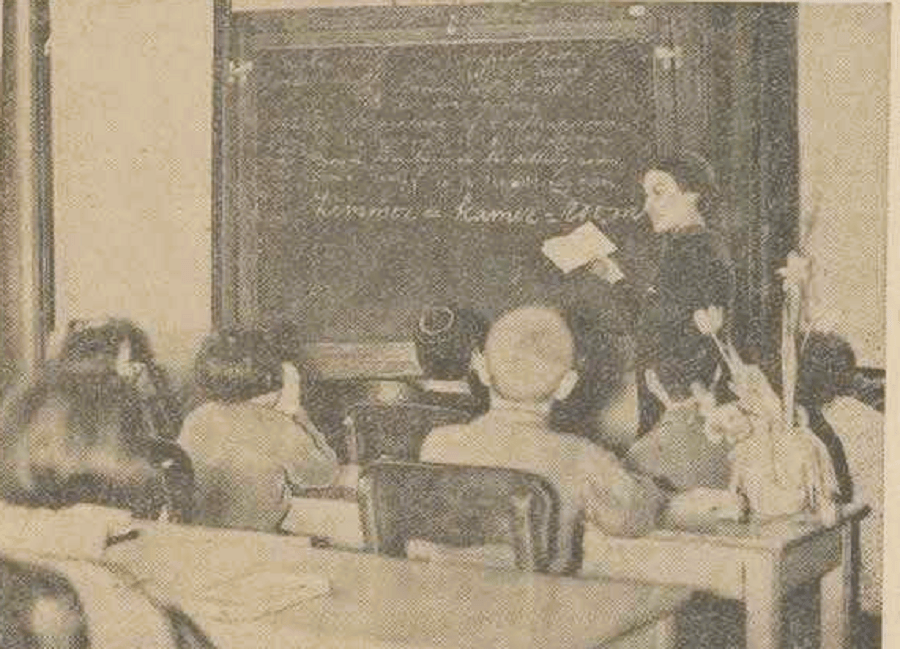
The picture at the start of the blog shows Rebecca in front of a class.

During World War II, the German occupiers systematically looted the possessions of Jewish Dutch citizens, including life insurance policies. On May 21, 1942, the Second Liro Decree came into effect, requiring Jews to surrender their life insurance policies to the German “plunder bank” Lippmann, Rosenthal & Co. Sarphatistraat (abbreviated as Liro). Over a year later, Decree 54/1943 mandated that life insurance policies held by Jews with an insured value of more than 500 guilders as of June 30, 1943, be terminated. Insurance companies were forced to pay the cash surrender value of these policies to Liro. This generated over 26 million guilders for Liro.
Liberation
During the occupation, the Dutch government in London began preparing for post-war restitution. The Occupation Measures Decree of September 17, 1944, declared anti-Jewish property regulations invalid.
After the liberation, it became clear that most Jewish policyholders had not survived. Since the forced cashing out of these policies was deemed invalid under the Occupation Measures Decree, insurers were required to pay out these policies to the heirs. Insurers resisted this obligation, arguing that they had already been forced to pay the policies to Liro during the war and should not have to pay twice.
Restitution
The insurers’ resistance led to a series of lawsuits between 1946 and 1949 before the Council for Restitution. Most rulings favored the heirs, leading to a system of amicable restitution. Insurers were allowed to reclaim the cash surrender amounts from Liro and then pay the policies to the heirs.
Not all policies were claimed by heirs. According to the Civil Code, unclaimed policies were classified as unclaimed inheritances and transferred to the State of the Netherlands. In 1954, the State and insurers reached the Veegens Agreement. This agreement stipulated that insurers would pay the cash surrender value of unclaimed policies to the State. If heirs subsequently came forward to claim a policy, the State would refund the surrender value to the insurer, which would then pay the policy to the heirs. This practice continued into the 1960s.
Sources
https://www.joodsmonument.nl/nl/page/190108/rebecca-elizabeth-beek
https://www.oorlogsbronnen.nl/tijdlijn/Rebecca-Elizabeth-Beek/48/14009
Donations
Your readership is what makes my site a success, and I am truly passionate about providing you with valuable content. I have been doing this at no cost and will continue to do so. Your voluntary donation of $2 or more, if you are able, would be a significant contribution to the continuation of my work. However, I fully understand if you’re not in a position to do so. Your support, in any form, is greatly appreciated. Thank you. To donate, click on the credit/debit card icon of the card you will use. If you want to donate more than $2, just add a higher number in the box left from the PayPal link. Your generosity is greatly appreciated. Many thanks.
$2.00


 History of Sorts
Leave a comment