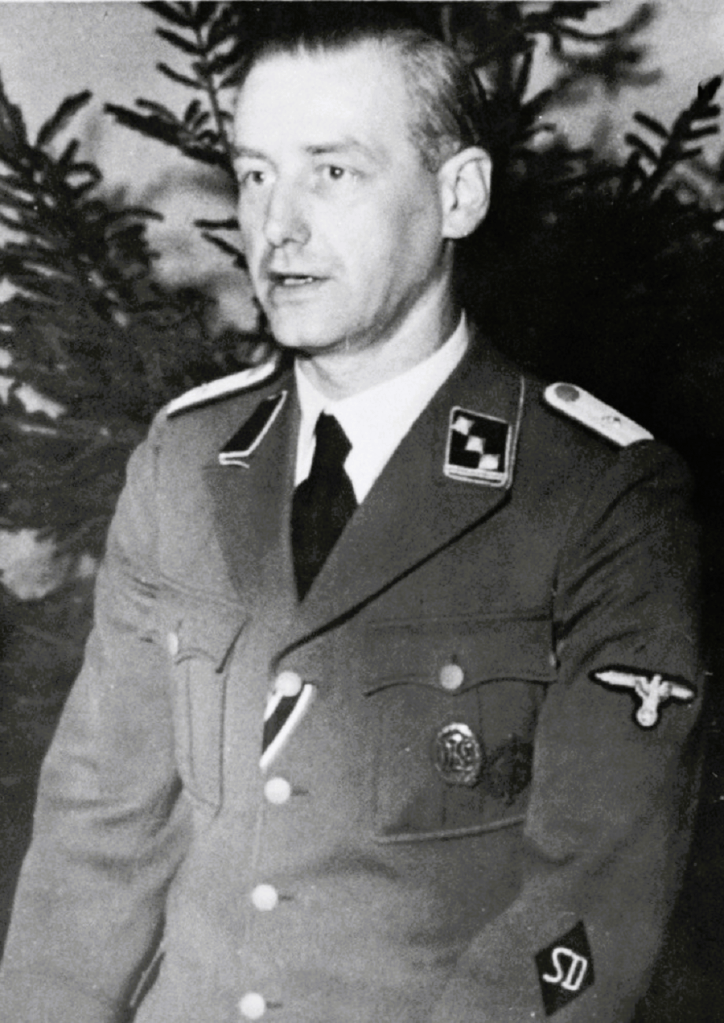
Albert Konrad Gemmeker (1907–1982) was a German SS officer who served as the commandant of the Westerbork transit camp in the Netherlands during World War II. Born on September 27, 1907, in Düsseldorf, Germany, Gemmeker pursued a career in law enforcement, joining the police force in Duisburg in 1933. By 1935, he held an administrative position with the Gestapo, reflecting his alignment with the Nazi regime.
Commandant of Westerbork
In October 1942, as the deportation of Jews from Western Europe intensified, Gemmeker was appointed commandant of the Westerbork transit camp. This camp, initially established by the Dutch government in 1939 to house Jewish refugees, was repurposed under German occupation as a transit point for Jews and Roma being deported to extermination camps in Poland. During his tenure, Gemmeker oversaw the deportation of approximately 80,000 Jews from the Netherlands. Despite his outwardly polite demeanor, earning him the moniker “gentleman-commandant,” Gemmeker was known for his strict enforcement of Nazi policies. He would order deportations for minor infractions, such as failing to show proper deference, and did not hesitate to send ill and disabled individuals on arduous journeys in cattle wagons.
Post-War Trial and Imprisonment
After World War II, Gemmeker was arrested and tried by the Special Court of Assen in 1949.

He was convicted of unlawful detention of Jews but not for complicity in genocide. Consequently, he received a relatively lenient sentence of ten years in prison. Demonstrating a lack of remorse, Gemmeker maintained that he was unaware of the ultimate fate awaiting the deported individuals. He was released in 1951 after serving only six years and returned to Düsseldorf, where he lived as a free man.
Starting in 1959, German judicial authorities made serious efforts to challenge the Dutch verdict against Albert Gemmeker. In 1949, the Special Court of Assen had convicted Gemmeker for the unlawful detention of arrested Jews but not for complicity in the genocide they suffered. The German public prosecutor sought to address this oversight, attempting twice to prosecute him for complicity in genocide. These investigations spanned a total of seventeen years. Ultimately, in 1976, Gemmeker was definitively acquitted because the prosecutor determined there was insufficient evidence to prove that he had knowledge of the fate awaiting his victims.

Throughout this period, Gemmeker consistently denied any knowledge of the Jews’ ultimate fate—even during twelve interrogations conducted by Dr. Wolfgang Steffen, the investigating judge. Researcher Ad van Liempt interviewed Dr. Steffen, who had conducted extensive interrogations of both witnesses and Gemmeker himself from 1971 to 1974. Dr. Steffen expressed his conviction that Gemmeker was indeed aware that the Jews he deported would not survive the concentration camps. However, despite Dr. Steffen’s belief that the case warranted a trial, he was unable to influence the independent prosecutor in Düsseldorf, who decided against proceeding to court.
In the course of his research, Van Liempt also interviewed two daughters and a granddaughter of the former camp commander. The daughters, who had not lived with Gemmeker for long due to their parents’ divorce during their childhood, expressed significant doubts about his credibility. The research revealed that Gemmeker made numerous false statements during his interrogations. For instance, he claimed that, while working for the Gestapo in Düsseldorf during the 1930s, he had no involvement in hostilities against German Jews. After his release from a Dutch prison, he sought denazification but omitted any mention of his past as a camp commander. Furthermore, when a document surfaced showing that he had attended a meeting with Adolf Eichmann—the infamous architect of the Holocaust—Gemmeker flatly denied being present.
Seventeen years of investigation into Gemmeker’s culpability ultimately failed to provide definitive answers about the extent of his knowledge and complicity in the genocide of European Jews.
Legacy
Albert Konrad Gemmeker’s tenure as commandant of Westerbork remains a stark example of the bureaucratic facilitation of genocide. His ability to maintain a facade of civility while orchestrating mass deportations underscores the chilling efficiency with which the Nazi regime implemented the Holocaust. The delayed and ultimately incomplete pursuit of justice in his case highlights the difficulties faced in holding individuals accountable for such atrocities.
sources
https://research.rug.nl/en/publications/gemmeker-commandant-van-kamp-westerbork
https://www.rug.nl/research/biografie-instituut/medewerkers/biography-albert-gemmeker?lang=en
https://nl.wikipedia.org/wiki/Albert_Konrad_Gemmeker
https://collections.yadvashem.org/en/photos/40779
https://collections.ushmm.org/search/catalog/pa24289
Please support us so we can continue our important work.
Donations
Your readership is what makes my site a success, and I am truly passionate about providing you with valuable content. I have been doing this at no cost and will continue to do so. Your voluntary donation of $2 or more, if you are able, would be a significant contribution to the continuation of my work. However, I fully understand if you’re not in a position to do so. Your support, in any form, is greatly appreciated. Thank you. To donate, click on the credit/debit card icon of the card you will use. If you want to donate more than $2, just add a higher number in the box left from the PayPal link. Your generosity is greatly appreciated. Many thanks.
$2.00
 History of Sorts
Leave a comment