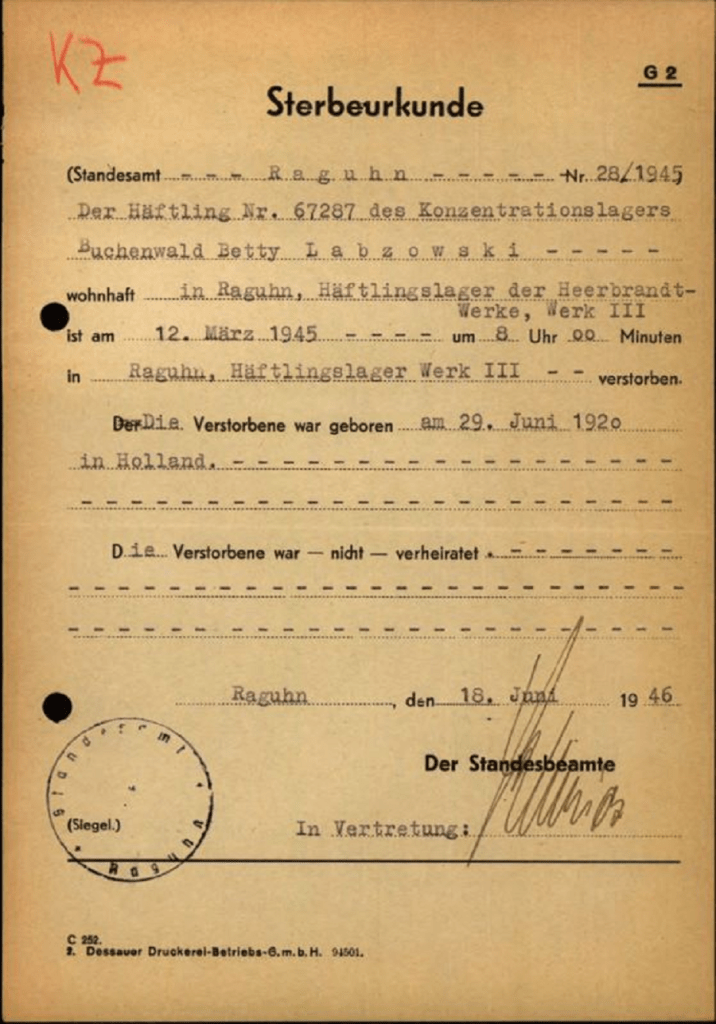
Raguhn, a subcamp of the Buchenwald concentration camp, was established during World War II in the village of Raguhn, Germany. This relatively small camp housed between 500 and 700 female prisoners, primarily Jewish women and girls, who were subjected to forced labor at a nearby aircraft parts factory operated by Junkers Flugzeug- und Motorenwerke AG.
The existence of Raguhn highlights the vast network of Nazi subcamps designed to exploit forced labor for the war effort. Prisoners endured relentless hardship, inadequate shelter, and the ever-present danger of air raids, all while suffering the psychological torment of imprisonment. The story of Raguhn stands as a stark reminder of the atrocities committed during this dark chapter of history and the resilience of those who endured unimaginable suffering.
The document at the top of this blog is the death certificate of Betsy Labzowski. She perished in the camp on March 12, 1945.
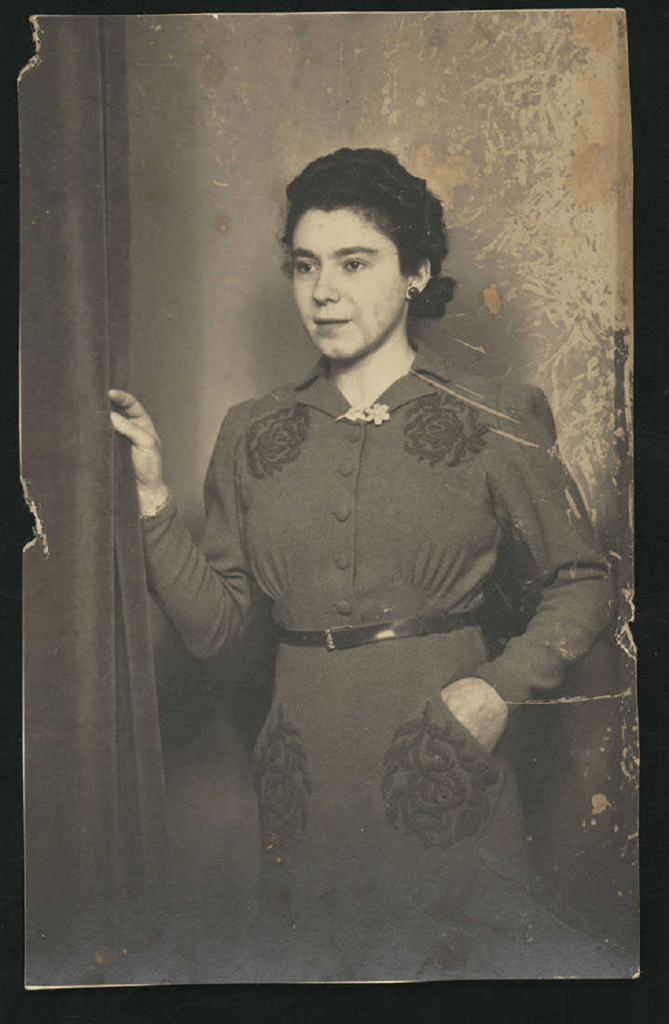
She was only 24 when she was murdered—a beautiful young woman with a future ahead of her. Who knows what she might have become? A doctor, a secretary, an actress, a model, a teacher, a wife, a mother. Her possibilities were endless. But on March 12, 1945—less than two months before the war’s end—Betty’s future was stolen by an evil regime.
I wish I could say it was only the Germans who were responsible for her death, but that would be a lie. The occupying Nazi regime was aided by civil servants and an efficient Dutch administration. Some acted out of fear, but not all.
It is a painful stain on my country’s history, though, thankfully, most people acknowledge it. Yet, there are other European nations that have yet to fully confront their past. Instead of facing history, some choose to revise it. Do they not see that the same ideology that once killed millions—including many of their own citizens—is reemerging?
I hope Betty’s death was not just a statistic, but a lesson for all of us
One notable prisoner was Auguste van Pels, known from Anne Frank’s diary. She was transported to Raguhn from Bergen-Belsen on February 7, 1945, and assigned registration number 67357. At Raguhn, she endured forced labor until early April 1945, when the approaching U.S. troops prompted the SS to evacuate the camp. On April 9, 1945, the prisoners were loaded into freight wagons bound for Theresienstadt. During this harrowing journey, Auguste van Pels died, though accounts of her death vary.

On February 7, 1945, Auguste van Pels was transported from Bergen-Belsen concentration camp to Raguhn for forced labor. Raguhn, a relatively small subcamp of Buchenwald, was located on the western edge of the German village of Raguhn. The camp was overseen by the SS-Kommando Heerbrandtwerke AG, led by SS-Hauptscharführer Herbert Dieckmann (1906–1986) and SS-Obersturmführer Hermann Grossmann (1901–1948). Approximately 45 male and female guards were stationed there.
Buchenwald and Its Subcamps
Buchenwald, one of the first and largest concentration camps on German soil, was established in 1937. Between 1938 and 1945, around 240,000 people were imprisoned there. Like many other camps, Buchenwald operated a vast network of subcamps, known as outer camps or (outer) commands, scattered over a large area.
Upon arrival in Raguhn, female prisoners were re-registered. Since the camp was administratively part of Buchenwald, they were included in its records and assigned ‘Buchenwald numbers.’
Forced Labor at Raguhn
Between 500 and 700 women were forced to work in an aircraft parts factory operated by Junkers Flugzeug- und Motorenwerke AG. They were required to wear striped prisoner uniforms for easy identification. Under the supervision of plainclothed civilian overseers, they assembled aircraft components.
The women endured grueling conditions, working in alternating day and night shifts. However, the chaotic final months of the war led to severe material shortages, often leaving them without enough work. Frequent Allied bombing raids also forced them to interrupt their labor to seek shelter.
Living Conditions
Unlike other camps, the women in Raguhn were not housed in standard barracks but in repurposed workshops and sanitary facilities. Starvation was rampant, and around 10% of the prisoners were too ill to work. Many had already arrived in poor health from Bergen-Belsen. As conditions worsened, a typhus outbreak spread through the camp. Women died from various causes, including pneumonia, heart failure, meningitis, and intestinal diseases.
Evacuation and Auguste van Pels’ Death
As U.S. troops advanced toward Buchenwald in early April 1945, the SS ordered the evacuation of Raguhn. On April 9, 1945, the women were once again crammed into freight wagons, this time bound for Theresienstadt. The chaotic journey lasted until April 16, 1945. Tragically, Auguste van Pels did not survive the transport and died along the way.
Sources
https://research.annefrank.org/en/locaties/a39467ab-0152-4645-9450-72349602960e/
https://www.joodsmonument.nl/nl/page/119491/betsy-labzowski#intro
https://www.jewishgen.org/forgottencamps/general/listeeng.html
Please support us so we can continue our important work.
Donation
Your readership is what makes my site a success, and I am truly passionate about providing you with valuable content. I have been doing this at no cost and will continue to do so. Your voluntary donation of $2 or more, if you are able, would be a significant contribution to the continuation of my work. However, I fully understand if you’re not in a position to do so. Your support, in any form, is greatly appreciated. Thank you. To donate, click on the credit/debit card icon of the card you will use. If you want to donate more than $2, just add a higher number in the box left from the PayPal link. Your generosity is greatly appreciated. Many thanks.
$2.00

 History of Sorts
Leave a comment