
German troops invaded the Netherlands in May 1940. The Nazi regime stayed in power in the Netherlands until May 1945. However, the Allies had already liberated the southern provinces in the autumn of 1944.
Despite the occupation, life went ahead as usual for many, at least to some extent. The Nazi occupiers still allowed sporting events. I have often wondered why that was, but of course, sports were ideal for propaganda purposes. They created an illusion to show the citizens that the Nazis weren’t all that bad. Also, sports functioned as a distraction.
Cycling has always been popular in the Netherlands. Many Dutch still use bicycles as their preferred means of transport. It has also always been popular in a sporting sense, and there have been many successful Dutch cyclists throughout the decades.
Therefore, it is no wonder that the Dutch continued to organize cycling events like the Cauberg Criterium, an annual race in the most southeastern part of the Netherlands, the province of Limburg, in Valkenburg.
Two cyclists who would have competed in these races were Jan van Hout and Cor Wals.
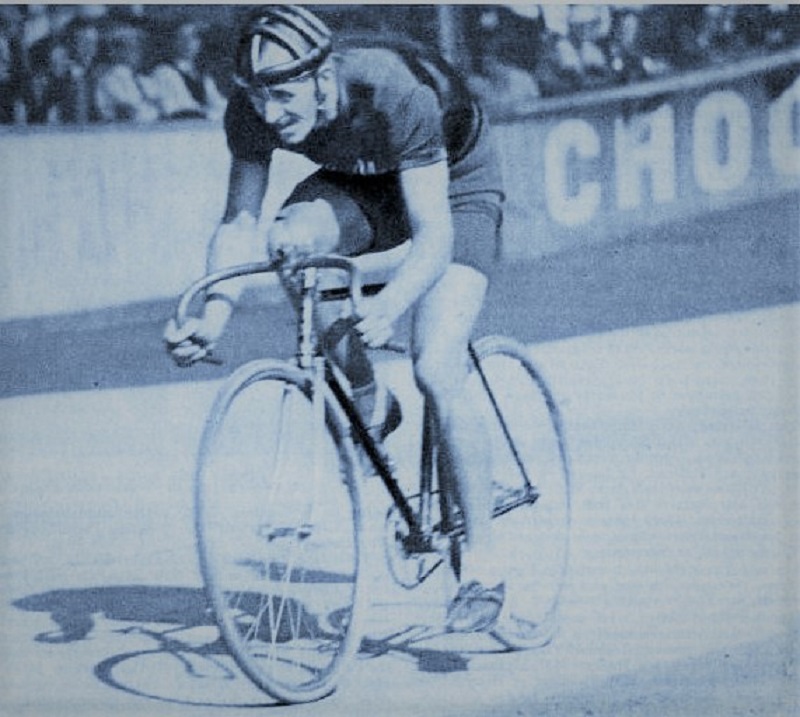
Jan van Hout, born October 17, 1908, in Valkenburg, was a professional cyclist between 1933 and 1940.
He made quite a good living as a cyclist. With the money he earned as a cyclist, he was able to buy a pub in Eindhoven. When the Nazis occupied the Netherlands, he closed his pub. He did not want to serve any drinks to the Nazis. He was a fervent anti-Nazi. After he closed the pub, Jan and his wife Anneke decided to join the Dutch resistance. They were involved in providing aid to refugees and people in hiding.
In the months leading up to liberation, Jan was arrested during a raid and subsequently sent to the Neuengamme Concentration Camp, where he tragically died on February 22, 1945.

Cor Wals was a Dutch cyclist, born February 26, 1911, in The Hague.
As early as 1931, Cor got contracts for the six-day races in Chicago and New York and made a name for himself as a six-day driver in the following years. Because of his unparalleled sense of balance, which stopped him from falling off the bike, he was nicknamed “Slingerplant” (Dutch: creeper). He took part in 39 races, of which he won seven. In addition, he was three times Dutch master of the stayers (aka The pacemaker race, an endurance discipline of track cycling).
He was a fan favorite. However, on July 21, 1941, during one of those stayers races, he took off his jacket, and to the shock of the spectators, they saw he was wearing a shirt with the SS symbol. He also gave the Hitler salute.
After winning the championship, he was whistled and booed during his lap of honor, and cushions were thrown at him. He decided not to race again and to focus on a military career with the SS.
Initially, he fought on the eastern front but worked as a guard in several concentration camps. There was an unverified rumor that he worked in Neuengamme when Jan van Hout was there.
After the war, Cor Wals was tried and sentenced to 15 years. The government released him in 1952.
He opened up a clothes shop in Eindhoven. One day, Anneke van Hout-Louwers, the widow of Jan van Hout, walked into the shop to buy some clothes for her son. Cor chatted with Anneke and Cupid struck. The couple were married. There was a public outrage about the newly married couple. People were disgusted that Anneke married a traitor. The couple moved to Belgium soon after, they returned to the Netherlands in 1981.
Sources
https://www.nu.nl/sport/2415527/sser-won-nk.html
https://amp.de.googl-info.com/5381126/1/jan-van-hout.html
Please support us so we can continue our important work.
Donation
Your readership is what makes my site a success, and I am truly passionate about providing you with valuable content. I have been doing this at no cost and will continue to do so. Your voluntary donation of $2 or more, if you are able, would be a significant contribution to the continuation of my work. However, I fully understand if you’re not in a position to do so. Your support, in any form, is greatly appreciated. Thank you. To donate, click on the credit/debit card icon of the card you will use. If you want to donate more than $2, just add a higher number in the box left from the PayPal link. Your generosity is greatly appreciated. Many thanks.
$2.00

 History of Sorts
Leave a reply to tzipporahbatami Cancel reply