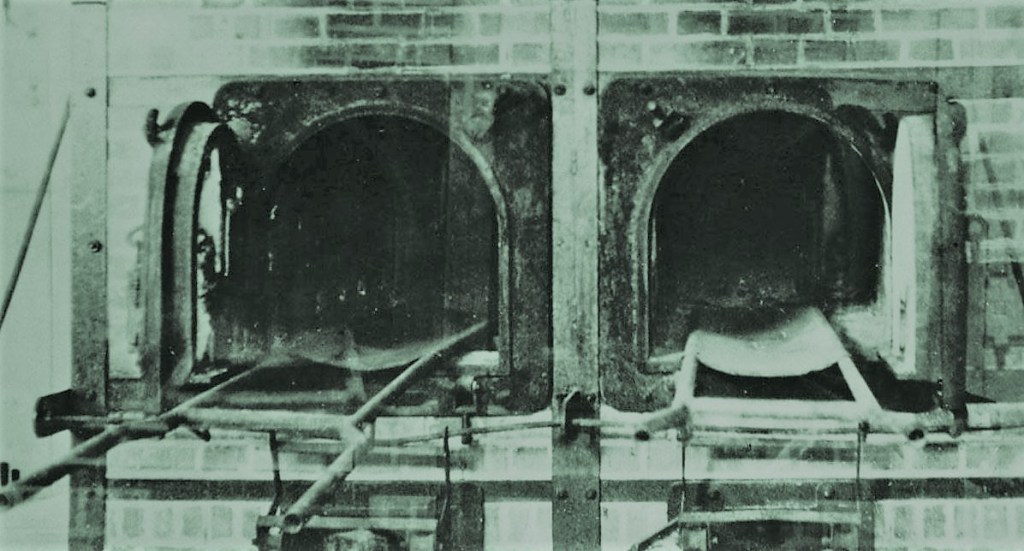
One of the most disturbing aspects of the Holocaust is the “wholesale murder” approach the Nazis took, the industrialization of death.
The gassing already started in 1939 as part of the T4 program, the murder of the disabled. What is really sickening is the fact that the first of such killings was at the request of the parents of a severely disabled child. The T4 murders were relatively small-scale, for lack of a better word, compared to the gassings that took place in Auschwitz, Chelmno, Sobibor, and the other extermination camps.
The gassings suggested a kind, humane way of killing. But there was nothing humane about it. It was only humane for the perpetrators. After the June 1941 German invasion of the Soviet Union and the Einsatzgruppe mass shootings of civilians, the Nazis experimented with gas vans for mass killing. The Nazis used hermetically sealed trucks with engine exhaust diverted to the interior compartment. Use of gas vans began after Einsatzgruppe members complained of battle fatigue and mental anguish caused by shooting large numbers of women and children. Gassing also proved to be more effective and cheaper.
On October 24, 1980, Lesław Dyrcz, a student from the Brynek Forestry Vocational School, found a leather briefcase buried at about 40 centimeters deep in the ground while clearing the area around Birkenau crematorium III of stub and roots. Inside the case was a thermos liner which had belonged to Marcel Nadjari, a Jewish Greek.
In November 1944, two months before the liberation of the camp, Nadjari had buried a twelve-page manuscript written in Greek on November 3 on pages taken from a notebook, in which he described his observations of Auschwitz.
In his manuscript, he wrote, “I want to live, to avenge the deaths of Dad and Mum, and that of my beloved little sister Nelly.”
Below are some notes from his manuscript.
“Our work was first to welcome them. Most didn’t know their fate. They laughed or cried. They were told they were going to take a shower and they went clueless to [their] death. To date, my dear ones, I don’t tell them they they are going for a shower, although I can lie to them, I only told them that I didn’t understand the language they spoke, and to the comrades, men and women, that I realised were doomed I told the truth.”
“Almost every time they kill, I wonder if there is a God and yet I have always believed in Him and still believe that God wants it, let His will be.”
“Often I thought of going in with the others, to put an end to this. But always revenge prevented me doing so. I wanted and want to live, to avenge the death of Dad, Mum and my dear little sister,”
“The crematorium is a big building with a wide chimney and 15 ovens. Under a garden there are two enormous cellars. One is where people undress and the other is the death chamber. People enter it naked and once about 3,000 are inside it is locked and they are gassed. After six or seven minutes of suffering they die.”
“The gas canisters were always delivered in a German Red Cross vehicle with two SS men. They then dropped the gas through openings – and half an hour later our work began. We dragged the bodies of those innocent women and children to the lift, which took them to the ovens.”
Nadjari did survive.
After the war, he married and, in 1951, moved to New York. He already had a one-year-old son, and in 1957, his wife Rosa gave birth to a girl, whom they named Nelli, after Marcel’s beloved murdered sister.
Sources
https://encyclopedia.ushmm.org/content/en/article/at-the-killing-centers
https://www.bbc.com/news/world-europe-42144186
https://encyclopedia.ushmm.org/content/en/article/gassing-operations
https://www.history.com/news/the-jewish-men-forced-to-help-run-auschwitz
Please support us so we can continue our important work.
Donation
Your readership is what makes my site a success, and I am truly passionate about providing you with valuable content. I have been doing this at no cost and will continue to do so. Your voluntary donation of $2 or more, if you are able, would be a significant contribution to the continuation of my work. However, I fully understand if you’re not in a position to do so. Your support, in any form, is greatly appreciated. Thank you. To donate, click on the credit/debit card icon of the card you will use. If you want to donate more than $2, just add a higher number in the box left from the PayPal link. Your generosity is greatly appreciated. Many thanks.
$2.00
 History of Sorts
Leave a comment