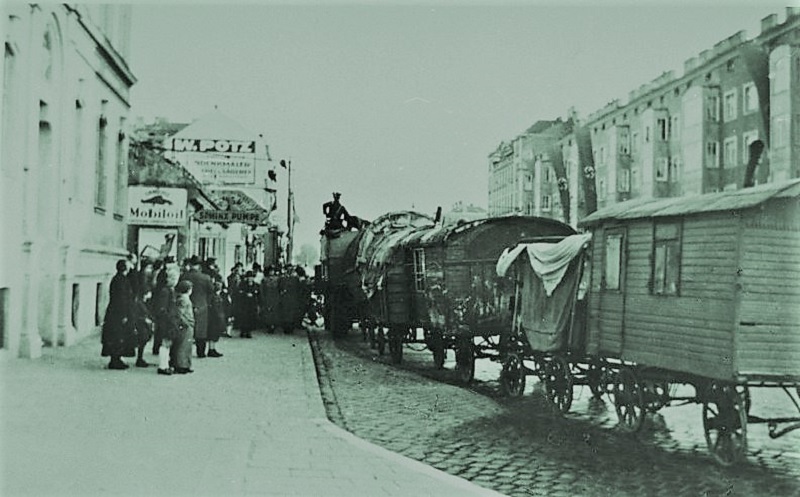
On 15 November 1943, Himmler ordered that Romani and “part-Romanies” were to be put “on the same level as Jews and placed in concentration camps.”
Between 1933 and 1945, Roma and Sinti in Europe were targets of Nazi persecution. The Nazi regime, building on long-held prejudices, viewed Roma as “a-socials” (outside “normal” society) and as racial “inferiors.” During World War II, the Nazis and their collaborators killed hundreds of thousands of Roma men, women, and children across German-occupied Europe.
Mass killings of Roma reached their pinnacle on July 31–August 2, 1944, when the Germans began the liquidation of the Zigeunerlager (“Gypsy camp”) at Auschwitz-Birkenau. Almost 3,000 Roma were put to death in this single operation.
Under the rule of Nazi Germany, the Roma were persecuted, detained and executed as part of the Holocaust. Roma calls the Roma Genocide the Porajmos, which means “Devouring” in Romani language.
Drawing support from many non-Nazi Germans who harboured social prejudice towards Roma, the Nazis judged Roma to be “racially inferior.” The fate of Roma, in some ways, paralleled that of the Jews. Under the Nazi regime, German authorities subjected Roma to arbitrary internment, forced labour, and mass murder. German authorities murdered tens of thousands of Roma in the German-occupied territories of the Soviet Union and Serbia and thousands more in the killing centres at Auschwitz-Birkenau, Chelmno, Belzec, Sobibor, and Treblinka. The SS and police incarcerated Roma in the Bergen-Belsen, Sachsenhausen, Buchenwald, Dachau, Mauthausen, and Ravensbrück concentration camps. Both in the so-called Greater German Reich and in the so-called Generalgouvernement—German civilian authorities managed several forced-labor camps in which they incarcerated Roma.
Under Adolf Hitler, a supplementary decree to the Nuremberg Laws was issued on 26 November 1935, classifying the Roma as “enemies of the race-based state.”
Under the July 1933 sterilisation law, many Roma were sterilised against their will.
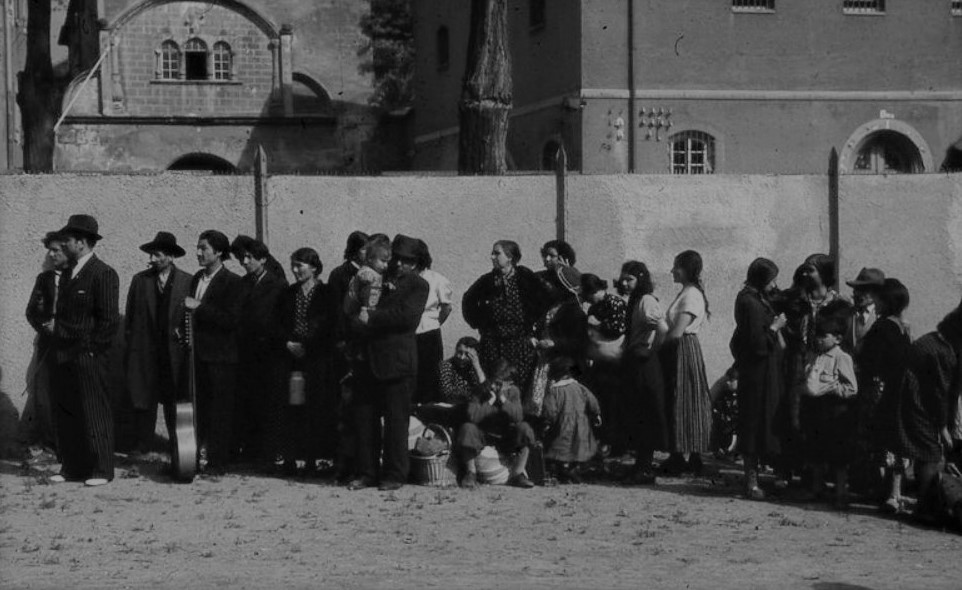
August 2nd is assigned Roma Holocaust Memorial Day because, on the night of 2nd August 1944, the remaining 2,897 Roma women, old men and children from the so-called “Zigeunerlager” or “Gypsy” camp were killed in gas chambers. There were no Roma and Sinti survivors from the Auschwitz Concentration Camp.
SS medical researchers assigned to the Auschwitz complex, such as SS Captain Dr. Josef Mengele, received government authorisation to choose human subjects for pseudo-scientific medical experiments from among the prisoners. Mengele chose twins and dwarves, some from the Gypsy family camp, as subjects of his experiments. Approximately 3,500 adult and adolescent Roma were prisoners in other German concentration camps; medical researchers selected subjects from among the Roma incarcerated in Ravensbrück, Natzweiler-Struthof, and Sachsenhausen concentration camps for their experiments, either on-site in the camps or at nearby institutes.

German military and SS-police units also shot at least 30,000 Roma in the Baltic States and elsewhere in the occupied Soviet Union, where Einsatzgruppen and other mobile killing units killed Roma at the same time that they killed Jews and Communists. In occupied Serbia, the German authorities killed male Roma in shooting operations during 1941 and early 1942. The total number of Roma killed in Serbia will never be known. Estimates range between 1,000 and 12,000.
In France, Vichy French authorities intensified restrictive measures against and harassment of Roma after the establishment of the collaborationist regime in 1940. In 1941 and 1942, French police interned at least 3,000 and possibly as many as 6,000 Roma, residents of both occupied France and unoccupied France. French authorities shipped relatively few of them to camps in Germany, such as Buchenwald, Dachau, and Ravensbrück.
Robert Ritter was a German racial scientist doctor of psychology and medicine with a background in child psychiatry and the biology of criminality. In 1936, Ritter was appointed head of the Racial Hygiene and Demographic Biology Research Unit of Nazi Germany’s Criminal Police to establish the genealogical histories of the German Gypsies, both Roma and Sinti and became the architect of the experiments Roma and Sinti were subjected to. His pseudo-scientific “research” in classifying these populations of Germany aided the Nazi government in their systematic persecution toward a goal of “racial purity.”

Sometimes known as the “Forgotten Holocaust,” the Roma Genocide was excluded from the history of World War II for decades after the end of the war. There were no Roma witnesses at the Nuremberg Trials.
The genocide of the Roma people wasn’t formally recognised until 1982. Until then, the West German government denied that Roma were subjects of racially motivated persecution. Instead, it was insisted that Roma were imprisoned for their ‘asocial’ and ‘criminal’ characteristics, allowing the government to avoid responsibility for racial discrimination and compensation for genocide.
Sources
https://encyclopedia.ushmm.org/content/en/article/genocide-of-european-roma-gypsies-1939-1945
https://encyclopedia.ushmm.org/content/en/photo/victim-of-nazi-medical-experiments
https://encyclopedia.ushmm.org/content/en/article/nazi-medical-experiments
https://www.opensocietyfoundations.org/explainers/what-roma-genocide
Donation
Your readership is what makes my site a success, and I am truly passionate about providing you with valuable content. I have been doing this at no cost and will continue to do so. Your voluntary donation of $2 or more, if you are able, would be a significant contribution to the continuation of my work. However, I fully understand if you’re not in a position to do so. Your support, in any form, is greatly appreciated. Thank you. To donate, click on the credit/debit card icon of the card you will use. If you want to donate more than $2, just add a higher number in the box left from the PayPal link. Your generosity is greatly appreciated. Many thanks.
$2.00


 History of Sorts
Leave a comment