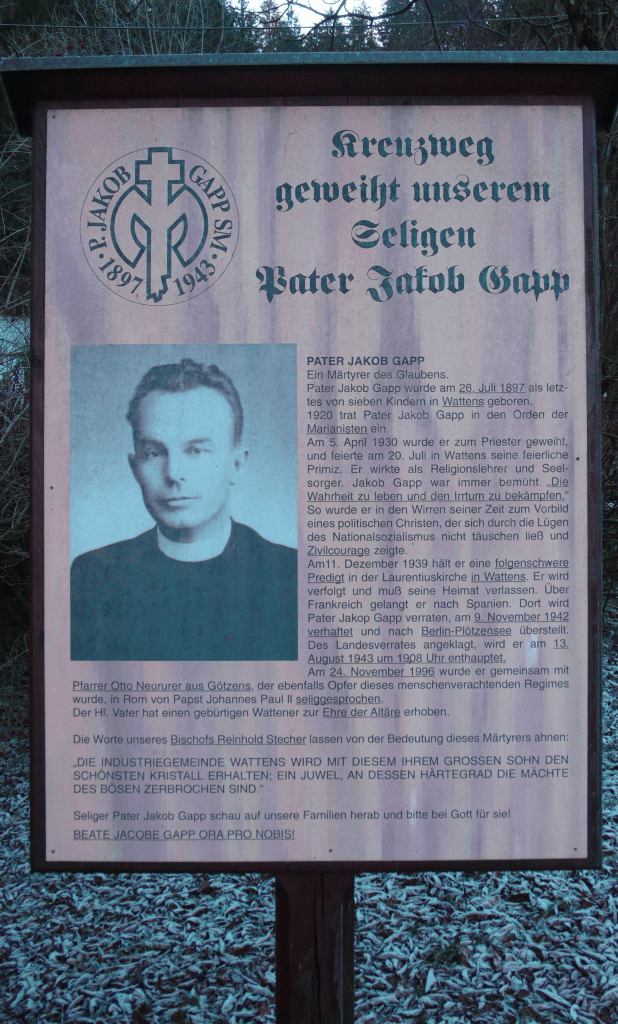
On July 26, 1897, in the Austrian village of Wattens, Jakob Gapp was born into a modest working-class family. He grew up like many boys in Tyrol: ordinary, hardworking, with no hint of the extraordinary courage that would one day define him. Yet his life would unfold in ways that would test the limits of conscience, faith, and defiance.
A Soldier’s Disillusionment
At nineteen, Gapp was pulled into the storm of the First World War. Drafted into the Austro-Hungarian army, he was sent to the Italian front where he was wounded twice and awarded medals for bravery.
But glory left him hollow. The mud, the screams, and the futility of war gnawed at him. Returning home, he found no peace in politics or nationalism. Instead, he began searching for something deeper—something that gave life meaning beyond survival and violence.
The Marianist Path
His search led him to the Marianists, formally known as the Society of Mary. Founded in France after the French Revolution, the order emphasized education, service to the poor, and living faith in community. Their focus was simple yet radical: to shape people through education and witness so that society itself could be transformed.
This mission resonated deeply with Gapp. He entered the Marianist novitiate in 1920 and was ordained a priest in 1930. Teaching in schools, preaching in parishes, and ministering to the poor, he threw himself into service with quiet zeal.
A Voice Against Fascism
By the 1930s, however, storm clouds were gathering again. Hitler’s ideas—racial supremacy, hatred of Jews, and blind worship of the state—spread from Germany into Austria. Many were seduced by promises of unity and strength.
Gapp was not. From his pulpit and in classrooms, he spoke bluntly: Nazism was incompatible with Christianity. He reminded his listeners that Jesus preached love of neighbor, not hatred of the “other.” He condemned the swastika as a symbol of idolatry, a rival creed masquerading as salvation.
Not everyone wanted to hear it. Some parishioners urged him to stop stirring trouble. Others denounced him. The Gestapo began to take notice. When the Nazis annexed Austria in 1938, Father Gapp was forced into exile—first to France, then to Spain.
Betrayal in Exile
Even abroad, Gapp continued his ministry and refused to keep silent. His outspoken opposition to Nazi ideology encouraged exiles and troubled sympathizers alike. But it also made him a marked man.
In 1942, Gestapo agents devised a trap. Disguised as seekers interested in converting to Catholicism, they lured Gapp into occupied France. Believing he was answering a call to serve, he crossed the border. Instead, he was arrested and transported to Berlin.
Trial and Execution
Before the Nazi court, the charges against him were laid out:
- He had denounced Hitler.
- He had defended Jews.
- He had condemned National Socialism as un-Christian.
Gapp didn’t deny it. He stood by his words. His conviction was inevitable.
In the summer of 1943, he awaited execution in Plötzensee Prison. There, he wrote letters—calm, clear, full of forgiveness. He thanked God for the grace to die for truth. To his Marianist brothers, he sent a final message: “Do not worry about me. I am in God’s hands.”
On August 13, 1943, at 7:08 p.m., Jakob Gapp was executed by guillotine. He was 46 years old.
A Lasting Witness
The Nazis thought they had silenced him. Instead, his death amplified his voice. In 1996, Pope John Paul II declared him Blessed Jakob Gapp, a martyr of the Catholic Church. His feast is celebrated every year on the anniversary of his death.
For the Marianists, and for many beyond, his life is a shining example of what it means to live faith without compromise: to reject lies, to defend human dignity, and to choose truth over survival.
Why Jakob Gapp Matters Today
Jakob Gapp wasn’t a politician or a general. He had no weapons, no power, no wealth. What he had was conscience—and the courage to follow it.
His story poses hard questions:
- What do we do when an ideology demands silence?
- Do we compromise, or do we resist?
- Do we see the humanity in all people, even when society tells us not to?
For Gapp, the answers were not negotiable. He chose truth, even when it meant death. That choice is why his witness still matters, decades later.
✦ Final Thought: Blessed Jakob Gapp’s life is not only about Catholic history. It is about the universal struggle between truth and lies, between dignity and oppression. Remembering him is a reminder that neutrality in the face of injustice is never neutral—it is complicity.
sources
https://en.wikipedia.org/wiki/Jakob_Gapp
https://www.catholicculture.org/culture/library/view.cfm?recnum=181
Donation
Your readership is what makes my site a success, and I am truly passionate about providing you with valuable content. I have been doing this at no cost and will continue to do so. Your voluntary donation of $2 or more, if you are able, would be a significant contribution to the continuation of my work. However, I fully understand if you’re not in a position to do so. Your support, in any form, is greatly appreciated. Thank you. To donate, click on the credit/debit card icon of the card you will use. If you want to donate more than $2, just add a higher number in the box left from the PayPal link. Your generosity is greatly appreciated. Many thanks.
$2.00
 History of Sorts
Leave a comment