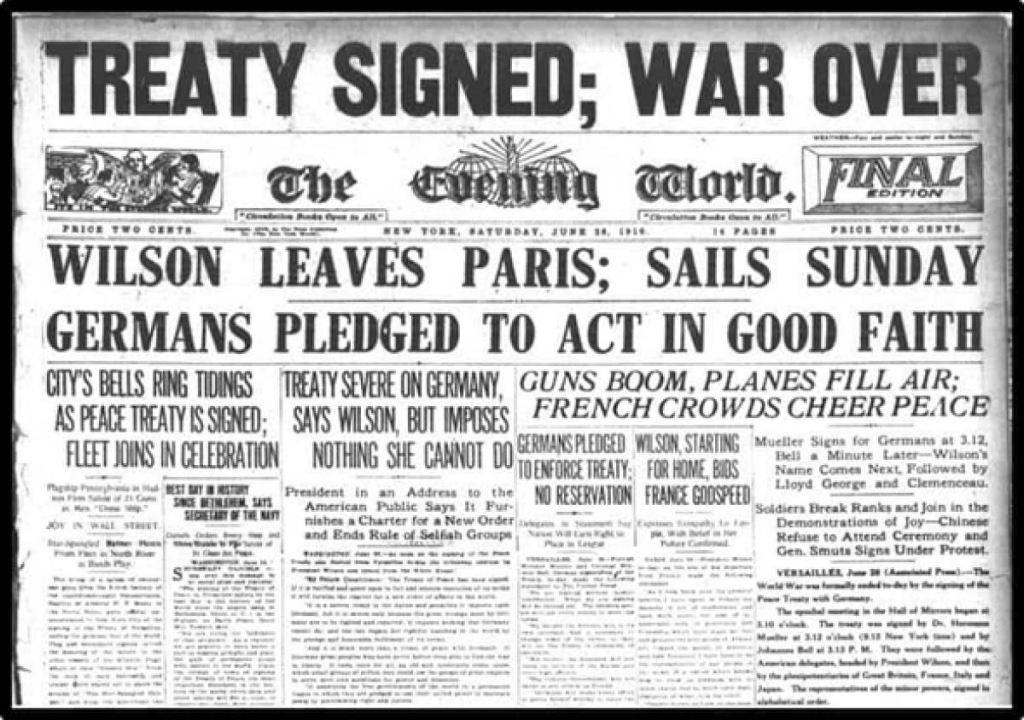
The title may sound unusual, but it reflects the difficulty of capturing this idea succinctly. One of the most damning aspects surrounding the Holocaust—arguably even more troubling than the staggering number of victims—is how the international community repeatedly stood by as Germany violated the Treaty of Versailles.
At multiple points, Germany’s military expansion could have been challenged or stopped. Instead, these violations were met with inaction or appeasement, allowing rearmament and territorial aggression to continue unchecked. Below is a list of some of the major breaches of the Treaty of Versailles
1️⃣ Treaty Articles Violated
A. Military Restrictions (Part V of the Treaty)
Army Size & Structure
Relevant Articles:
Art. 159 – German armed forces to be demobilized and reduced
Art. 160 – Army limited to 100,000 men, no general staff
Art. 161–163 – Strict limits on recruitment, service length, and prohibition of reserves
Violations:
Period Action Nature of Breach
1919–23 Freikorps & Einwohnerwehr De facto reserve forces
1921–23 Black Reichswehr Secret expansion structures
1935 Conscription reintroduced Total abandonment of manpower limits
Weapons Prohibitions
Relevant Articles:
Art. 164 – Strict limits on weapons production
Art. 168 – Weapons manufacture controlled
Art. 170 – Import/export of arms restricted
Art. 171 – Ban on tanks and heavy artillery
Art. 173 – Conscription forbidden
Violations:
Period Action Article Breached
1922 onward Tank research with USSR (Kazan) 171
1920s Secret weapons stockpiles 164, 168
1935 Reintroduction of conscription 173
Air Power Ban
Relevant Article:
Art. 198 – Germany forbidden to maintain military or naval air forces
Violations:
Period Action
1920s Secret pilot training in Lipetsk (USSR)
March 1935 Public creation of the Luftwaffe
Naval Restrictions
Relevant Articles:
Art. 181–197 – Severe limits on German navy (size, ship types, submarines banned under Art. 191)
Violations:
Period Action
Early 1930s Secret U-boat design work
1935 Naval expansion under Anglo-German Naval Agreement (contradicted Versailles limits)
B. Rhineland Demilitarization
Relevant Articles:
Art. 42 – Germany forbidden to build fortifications west of the Rhine
Art. 43 – No armed forces in the Rhineland
Art. 44 – Violation considered a hostile act against signatories
Violation:
March 7, 1936 – German troops entered and later fortified the Rhineland.
C. Territorial & Political Clauses
Union with Austria
Relevant Article:
Art. 80 – Germany must respect Austria’s independence; union forbidden without League consent
Violation:
March 1938 – Anschluss
Respect for Neighboring States’ Sovereignty
While not always a single-article breach of Versailles itself, Germany’s later expansion violated the post-Versailles territorial settlement and related treaties.
Event Legal Framework Undermined
Sudetenland (1938) Versailles system + League guarantees
Occupation of Czechoslovakia (1939) Munich framework + international law
2️⃣ Why the Allies Failed to Enforce the Treaty
1919–1923: Limited Capacity & Political Instability
Europe was exhausted economically and militarily after WWI
France wanted strict enforcement; Britain preferred German recovery
Fear that crushing Germany would cause Bolshevism to spread westward
Many early violations were covert and deniable
Result: Weak inspection and tolerance of paramilitary activity.
1920s: Illusion of Cooperation
Locarno Treaties (1925) improved diplomatic relations
Germany joined the League of Nations (1926)
Secret rearmament was hard to prove conclusively
Western powers prioritized economic stabilization (Dawes & Young Plans)
Result: Deliberate under-enforcement to preserve political détente.
Early 1930s: Global Crisis
Great Depression crippled Britain and France
Political focus shifted to domestic survival
Rise of pacifism in democratic electorates
Underestimation of Hitler’s long-term goals
Result: Germany’s withdrawal from the League (1933) went unanswered.
1935 Rearmament Announcements
Britain believed some German rearmament was inevitable and even justified
France was politically divided and unwilling to act alone
The Stresa Front (UK–France–Italy) collapsed quickly
Result: No sanctions or military response.
1936 Rhineland Crisis
This was the last realistic chance to stop Hitler early.
Why no action?
French government instability; required British backing
British leaders viewed Germany as moving into “its own backyard”
Intelligence uncertainty exaggerated German strength
Strong anti-war sentiment
Reality: German forces had orders to retreat if opposed.
1938–39 Expansion
Policy of appeasement aimed to avoid another world war
Belief that satisfying “reasonable” German demands would ensure peace
Military unpreparedness in Britain and France
Deep trauma from WWI casualties
Turning Point: Occupation of all Czechoslovakia (March 1939) proved Hitler’s aims were not limited → guarantee to Poland followed.
Key Takeaway
Germany’s breaches evolved in three phases:
Covert circumvention (1920s) – Hard to detect, politically inconvenient to confront
Open rearmament (1935–36) – Could have been stopped, but willpower lacking
Territorial aggression (1938–39) – Appeasement collapsed only when war became unavoidable
Sources
https://guides.loc.gov/treaty-of-versailles
https://history.state.gov/milestones/1914-1920/paris-peace
https://encyclopedia.ushmm.org/content/en/article/treaty-of-versailles


 History of Sorts
Leave a reply to tzipporahbatami Cancel reply