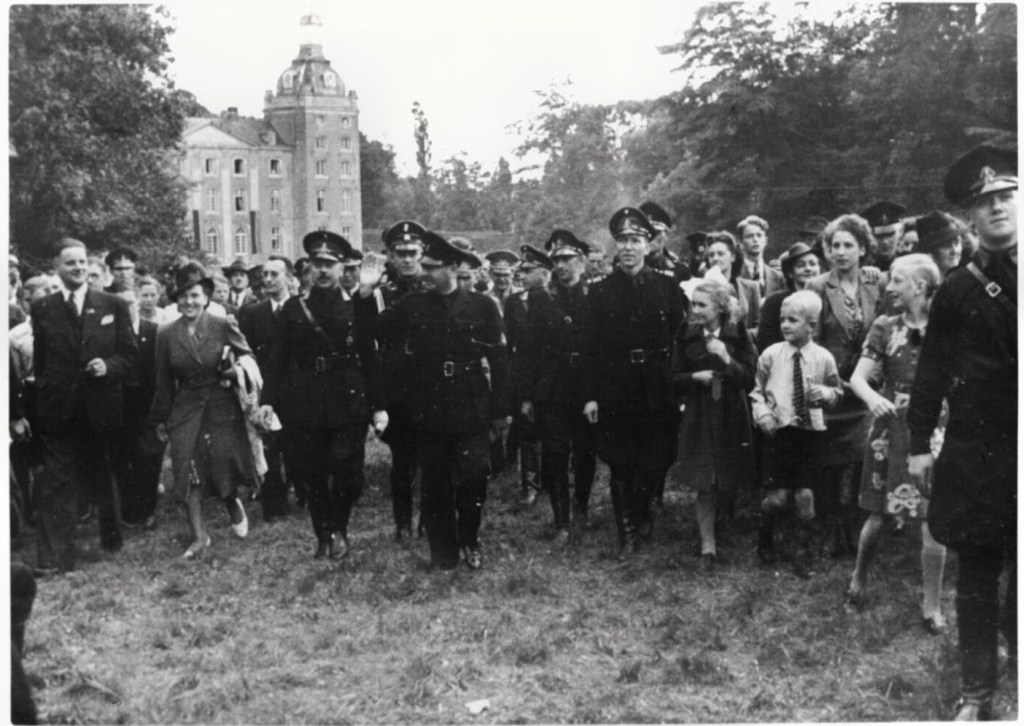
Before I delve into the main story, it is worth providing a brief synopsis of Limburg.
Limburg is the southernmost of the twelve provinces of the Netherlands and stands apart from the rest of the country due to its distinctive geography, strong historical connections to Central Europe, and unique cultural identity.
Unlike the famously flat, sea-level landscape that characterizes much of the Netherlands, southern Limburg is defined by rolling green hills, known locally as the Heuvelland. The region is home to the Vaalserberg, the highest point on the Dutch mainland, reaching an elevation of 322.5 meters. This hill also marks the Drielandenpunt (Three-Country Point), where the borders of the Netherlands, Belgium, and Germany converge. Flowing from south to north through the province, the Meuse River (Maas) has shaped fertile valleys that have long supported settlement and agriculture.

In the 1930s, the global economy was in a bad state. The Great Economic Depression also affected the Netherlands at the time. At the beginning of this period, in 1931, a new political party was founded: the National-Socialist Movement, or NSB (Nationaal-Socialistische Beweging). Its founder was Anton Mussert (1894–1946). His party grew rapidly and opposed parliamentary democracy (democracy with a parliament, or popular representation). According to him, this only led to division among the population and to “weak chatter” and quarreling in parliament. Mussert and his followers believed that governance by a single strong party with one powerful leader would ensure unity and offer the people a better future. This would make the Netherlands a strong state within Europe once again. Mussert had great admiration for the Italian dictator Benito Mussolini (1883–1945) and later also for Adolf Hitler (1889–1945). The goals of the NSB therefore hardly differed from those of the German National Socialists. An important difference between the NSB and Hitler’s Nazi party (derived from “Nazism,” or the “National Socialism” movement) was that the NSB did not immediately adopt Hitler’s racist and antisemitic (anti-Jewish) beliefs. That only happened later.
The NSB in Limburg
During the crisis years, quite a few Dutch people lost their faith in parliamentary democracy. The NSB profited from this. The party gained tens of thousands of members, and NSB members were elected to the Senate and the House of Representatives. These NSB politicians did not sit there to participate in what they saw as the “parliamentary hassle,” but to make it clear in speeches that they were actually opponents of parliamentary democracy. The NSB ideology could count on support among all layers of the population and in all parts of the country. In Limburg, the party achieved a higher percentage of votes in the 1935 Provincial Council elections than in the other provinces: 11.69 percent compared to 7.7 percent nationwide. This could be explained by the fact that many people from Limburg had family in Germany and lived close to the German border. As a result, the people in Limburg were quite well informed about the economic improvements in Germany brought about by Hitler’s National Socialism.
NSB Figurehead
One of the most famous NSB leaders in Limburg was a Catholic, pro-German nobleman: Max, Count de Marchant et d’Ansembourg (1894–1975). He lived at the Amstenrade Castle, where he had been mayor since 1925. He held this position until 1934. At that time, the government decreed that it was henceforth forbidden for people employed by the government to be members of the NSB. Because d’Ansembourg had joined Mussert’s movement in December 1933, he had to leave.
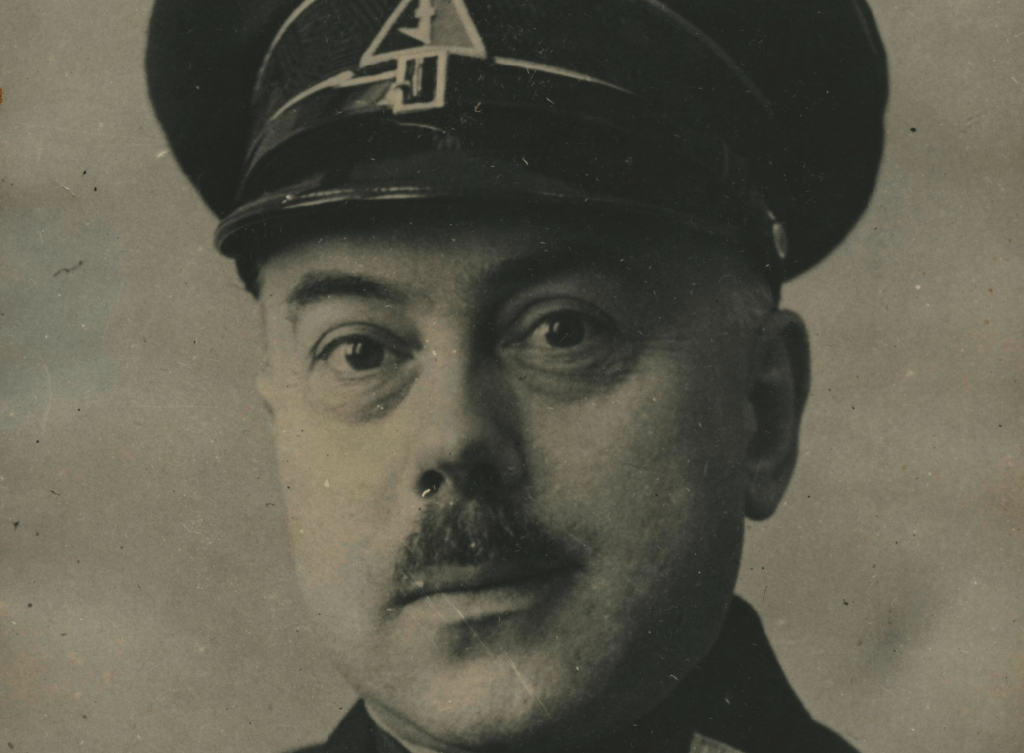
But this dismissal as mayor did not mean that d’Ansembourg’s political career was over. On the contrary: within the NSB, he grew into an important politician. For instance, in 1935, he became the parliamentary leader of the NSB in the Senate. From 1937, he fulfilled this role in the House of Representatives until the German occupation began in May 1940, and the occupying forces suspended the Dutch parliament. Like most of his fellow party members, d’Ansembourg was pleased with the German occupation, as the Netherlands now became part of Hitler’s National Socialist Third Reich. The German administration banned all Dutch political parties except for the NSB. During the occupation years, the NSB took increasingly extreme and also antisemitic positions. As a result, the NSB became disliked by the majority of the Dutch population.
Collaboration
During the occupation, the NSB cooperated with the German administration in many ways. NSB members helped the occupier by, among other things, holding mayoral positions or by tracking down Jewish people in hiding and resistance fighters. In addition, the NSB used its party newspaper, Volk en Vaderland (People and Fatherland), to produce propaganda for the occupier. NSB members also voluntarily enlisted in the German army, specifically the Waffen-SS. After their training, they went to fight against communism in the Soviet Union. d’Ansembourg chose the side of the German occupier. This is perhaps not so strange, given that his family had partly German roots. Furthermore, he had served in the German army throughout the entire First World War (1914–1918).
In February 1941, the Nazi regime appointed the Count as Commissioner of the Province of Limburg. It became his task to ensure that the mayors and their local officials in Limburg obeyed and executed German orders, including those regarding discrimination and the ultimate arrest and deportation of Jewish people. In his role as provincial commissioner, d’Ansembourg was the German occupier’s most important collaborator in the “Nazification” (derived from “Nazism”) of Limburg. d’Ansembourg remained in this position until early September 1944. At that time, the Allied armies were pushing the German army further and further back and were approaching Limburg. Therefore, he left for Germany with his family. There, in April 1945, d’Ansembourg was captured by the Limburg Regiment of the Dutch Shock Troops (Stoottroepen). This unit consisted largely of former resistance fighters and had meanwhile been attached as a temporary infantry unit to a division of the US Army.
After 1945
After the war, d’Ansembourg was sentenced to fifteen years in prison. In addition, he was stripped of his right to vote. For the rest of his life, he was no longer allowed to run for office or vote. In 1954, d’Ansembourg was released early. During the remainder of his life, he championed the local community in Amstenrade, just as he had done before. He supported the Catholic community, sponsored clubs, and provided financial assistance to businesses. He was also there for people who were in trouble. For example, the Count helped a widow, who had to leave her rental home through no fault of her own, by providing her with an upstairs apartment in one of his castle’s outbuildings. Furthermore, he secured jobs for unemployed villagers at the Emma State Mine. For these reasons, d’Ansembourg remained popular in Amstenrade even after the war, despite his role in the Nazi regime during the occupation years. The lord of the castle and former NSB commissioner passed away in 1975.
Edith Stein and Settela Steinbach Victims of the Nazi Regime
Both of these women became deeply tragic symbols of the Holocaust in the Netherlands, despite coming from entirely different backgrounds. They were only two among countless victims, yet through their stories I remember and honor all those who suffered and perished.
It is May 14, 1944. The German occupying forces send a message to the Dutch police units with the following command: “a central arrest of all persons residing in the Netherlands who possess the characteristics of gypsies.” The Nazi regime (derived from “Nazism,” or the “National Socialism” movement) wanted all Sinti and Roma families, who were known as “gypsies,” to be brought to the Westerbork camp in Drenthe. From here, nearly 250 Sinti and Roma were deported to the Auschwitz-Birkenau extermination camp after just a few days. Among them was the Sinti girl Anna Maria (Settela) Steinbach (1934–1944). A photograph was taken of her that would later become world-famous. Two years earlier, the Jewish sisters Edith (1891–1942) and Rosa Stein (1883–1942) had suffered a similar fate.
Hitler’s Racial Ideology
A key component of the National Socialist worldview of the Nazi regime was racial ideology. Adolf Hitler (1889–1945) believed that humanity could be divided into races based on certain characteristics. He was also convinced that the Aryan race, to which he counted Germans, was destined to rule over “inferior races.” According to him, the “most inferior” races were the Jews and the Sinti and Roma. The latter are originally a nomadic people. As Hitler gained more and more power during the second half of the 1930s and the first half of the 1940s, he slowly but surely made life impossible for the Jews and the Sinti and Roma. First, they were banned from public places. Furthermore, the Sinti and Roma were forbidden from traveling. Later, large-scale persecutions and mass extermination began. Many Jews tried to flee abroad. This is how the families of Anne Frank (1929–1945) and Edith Stein ended up in the Netherlands. But they turned out not to be safe here either, as the country was occupied by the Nazi regime during the Second World War (1940–1945)
Edith Stein
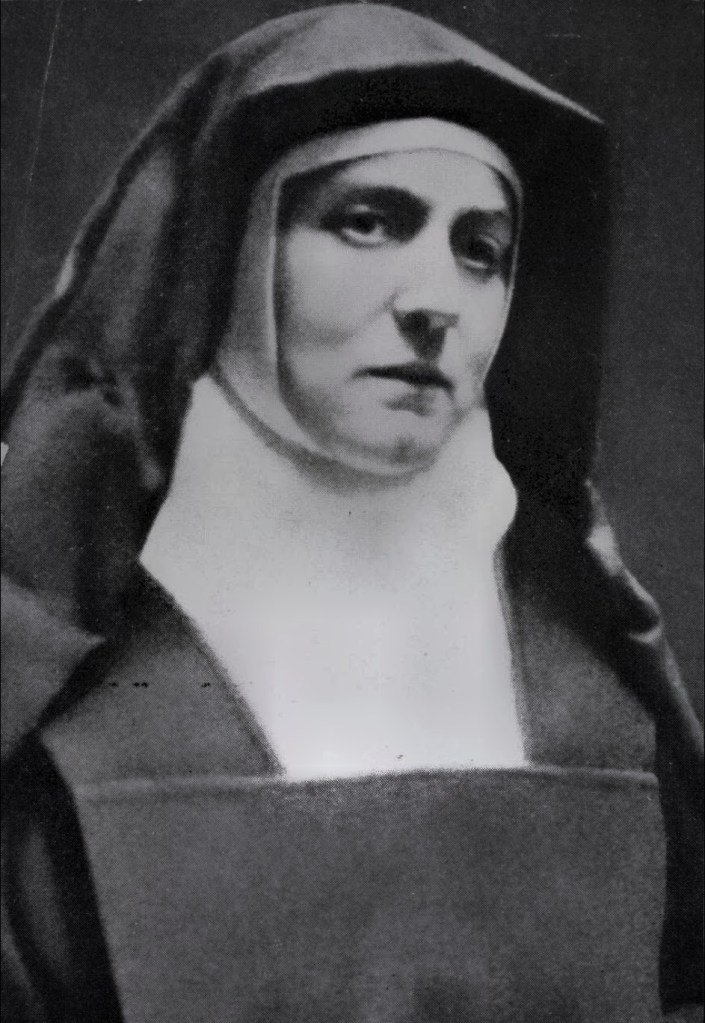
Edith came from a deeply religious Jewish family of eleven children living in Poland. She first attended a grammar school (gymnasium) and later studied German and history at the University of Breslau. Furthermore, she immersed herself in psychology and philosophy, two branches of the social sciences. Edith dedicated herself to human rights. Following the outbreak of the First World War (1914–1918), she nursed Austrian soldiers suffering from typhus on behalf of the Red Cross. She then worked at the universities of Freiburg and Münster, where she engaged in translating the works of the medieval philosopher and Dominican friar Thomas Aquinas. She also wrote philosophical works of her own. Due to Hitler’s anti-Jewish measures, she was dismissed in 1933. She fiercely resisted the Nazi regime: “Hitler is the greatest enemy of God and will lead us all to ruin.” After a long spiritual search, Edith converted to Catholicism. In 1934, she entered the convent of the Discalced Carmelites in Cologne. Out of fear of endangering the convent community due to her Jewish ancestry, Edith left for her fellow sisters in the Central Limburg town of Echt in 1938. On August 2, 1942, the Nazi regime arrested her and her Fellow sister Rosa, who was also pursuing the convent life as a convert at the time. Via camp Westerbork, where most Dutch Jews were gathered to be transported further to extermination camps in the east, the sisters ended up in Auschwitz-Birkenau. Immediately upon arrival, they were gassed.
Anna Maria (Settela) Steinbach
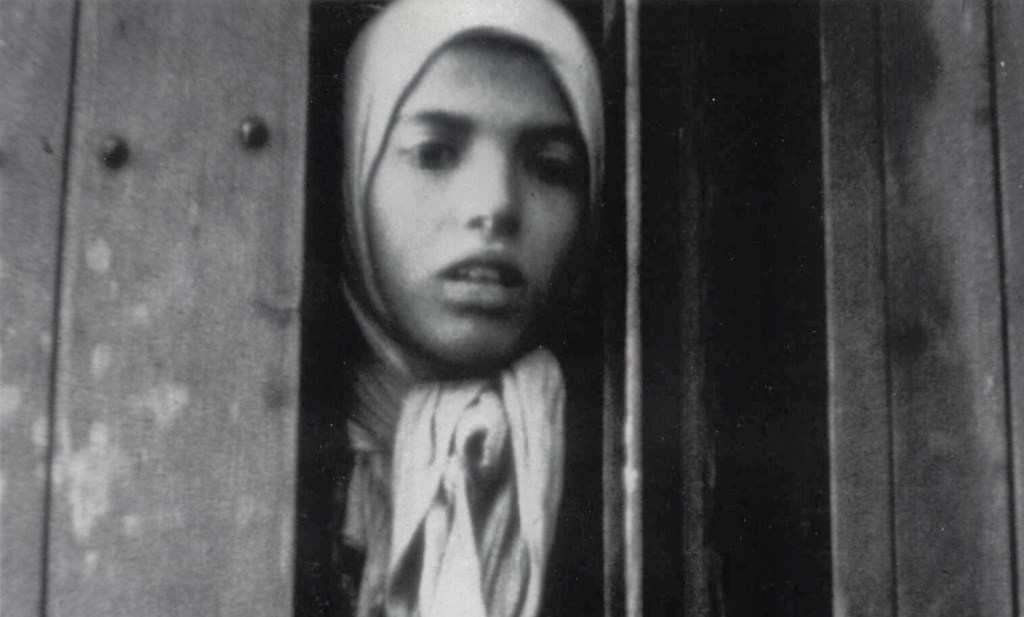
Anna Maria Steinbach was born as a Sinti girl on the outskirts of the South Limburg village of Buchten, near Sittard. According to Sinti and Roma custom, she was also given the call name Settela. Settela was the seventh of ten children in total from a large family with no fixed residence. Her father earned a living as a trader and violinist at fairs and village festivals around Sittard. When traveling with caravans was no longer allowed, the Steinbach family ended up at a central caravan camp in Eindhoven. On May 16, 1944, Settela was arrested in Eindhoven and sent to Westerbork. On May 22, 1944, she arrived with the other Sinti and Roma in Auschwitz-Birkenau. Here, she was placed with the others in a special “Gypsy camp” (Zigeunerlager). This accommodation was cleared at the end of July 1944. People who still had enough strength to work were transferred, while those left behind were murdered. Settela was gassed shortly thereafter. Only 32 of the Sinti and Roma who came from Westerbork survived the war. This included Settela’s father, who died of grief in 1946. The footage of Settela in the train wagon grew into the ultimate symbol of the persecution of Jews by the Nazi regime. Later, it was discovered that the girl in this photograph was not a Jewish girl, but a Sinti girl from Buchten.
Jews, Sinti, and Roma in Limburg
Due to the arrival of Jewish refugees, the number of Jews in Limburg rose to about 1,250 at the beginning of the Second World War. On July 11, 1942, the churches in the Netherlands protested against the deportation of Jews by the occupying forces and against the forced labor that Dutch people had to perform . Reich Commissioner Arthur Seyss-Inquart (1892–1946) promised, among other things, to spare the Jews. But this did not happen. In fact, the hunt for them was soon intensified. More than 800 Limburg Jews were killed in the various extermination camps. That is about two-thirds of the total number of Jews living in Limburg in 1940. Out of a total of 140,000 Jews in the Netherlands, three-quarters lost their lives during the Holocaust. In Limburg, a relatively high number of Jews managed to stay out of the hands of the oppressor. In Beek, for example, ten out of fifteen Jews survived the war. Before the outbreak of the war, the Netherlands counted about 4,500 Sinti and Roma who traveled across the country with their orchestras and merchandise. On May 16, 1944, virtually the entire community was taken to Auschwitz-Birkenau and murdered. Across Europe, it is estimated that between 220,000 and 500,000 Sinti and Roma were killed in concentration camps.
sources
https://www.canonvannederland.nl/nl/page/352858/de-nsb
https://www.canonvannederland.nl/nl/page/352859/edith-stein-en-settela-steinbach


Leave a Reply