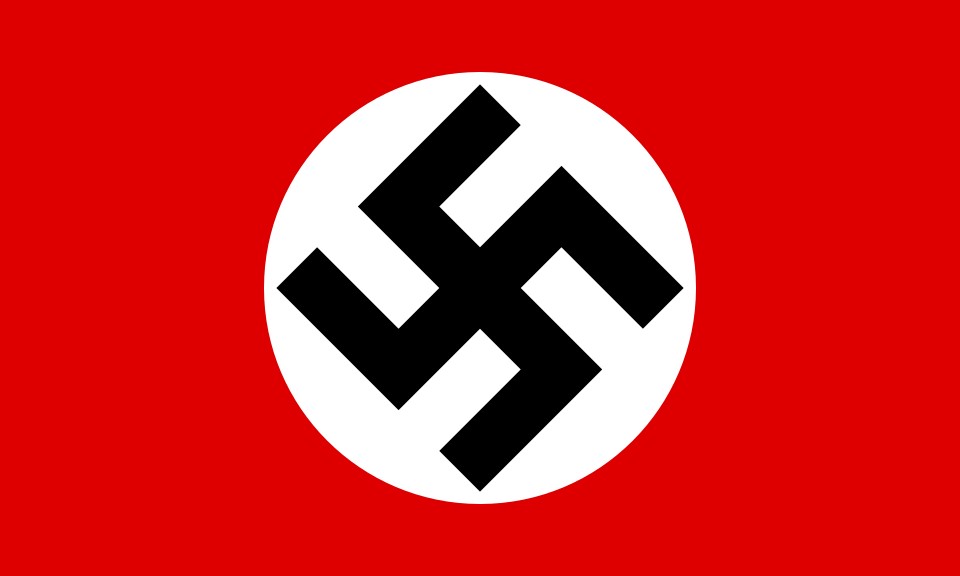
I was reluctant to write this blog, mainly because of the symbolism the flag has come to represent. However, it is an important part of history, and its adoption by Nazi Germany also illustrates just how little was truly original about Nazi symbolism and ideology.
The swastika itself was certainly not a Nazi invention. It is an ancient geometric symbol that has been used for thousands of years across cultures in Eurasia, as well as in parts of Africa and the Americas. Long before the Nazis appropriated it, the swastika had been used as a symbol of good fortune, divinity and spirituality in several religions, most notably Hinduism, Buddhism and Jainism.
Its meaning was therefore very different from the one that would become so deeply associated with Nazi Germany. The Nazis took an ancient symbol with a history stretching back thousands of years and transformed it into one of the most infamous political symbols of the twentieth century.
I’ve tightened the ending so it makes the point once rather than repeating the same conclusion. I also removed a little repetition around the swastika’s symbolism earlier in the essay.
The Flag of Nazi Germany: When the Swastika Became a National Symbol
On 15 September 1935, Nazi Germany formally adopted a new national flag bearing the swastika. The decision was more than a change of national colours. It represented the triumph of National Socialism over the symbols of the German Republic and the transformation of the swastika from a political party emblem into the visual symbol of a dictatorship.
The swastika itself was not a Nazi invention. It is an ancient symbol that had been used for thousands of years in different cultures, including in Europe and Asia, where it could represent concepts such as good fortune, eternity, or the movement of the sun. By the late nineteenth and early twentieth centuries, however, some European racial nationalists and völkisch movements had appropriated the symbol and attached racial and antisemitic meanings to it.
Adolf Hitler adopted the swastika as the emblem of the National Socialist German Workers’ Party (NSDAP). In Mein Kampf, Hitler described his involvement in designing the party’s flag. The red background, he explained, was intended to attract the socialists, while white represented nationalism and the black swastika represented the supposed struggle of the Aryan race.
The Nazi Party flag therefore deliberately combined colours and symbolism intended to communicate a political message. It was not simply a party banner; it was designed as propaganda.
When Hitler became Chancellor in January 1933, the Nazi flag began appearing alongside the black-white-red colours of the former German Empire. Initially, the regime retained the existing national flag while giving the swastika flag increasing prominence. On 12 March 1933, the government ordered that the black-white-red flag and the swastika flag be flown together on government buildings.
The symbolism was becoming increasingly clear. The old imperial colours represented Germany’s past; the swastika represented the political movement that now claimed to represent Germany’s future.
The final break came in September 1935, during the annual Nazi Party Rally in Nuremberg. On 15 September, the Reichstag, meeting at the Nazi Party Rally, passed the laws that became known collectively as the Nuremberg Laws, stripping German Jews of citizenship and formally defining them as racially separate from the German population.
On the same day, another law changed the national flag.
The legislation declared that the swastika flag was to become the Reich and national flag. The black-white-red flag associated with imperial Germany was discarded as the official national flag.
The timing was significant. The new flag was adopted on the very day that the Nazi regime institutionalised racial discrimination against German Jews. The flag and the Nuremberg Laws therefore emerged from the same political transformation: the creation of a state based on Nazi racial ideology.
The design was strikingly simple: a red field with a white circle containing a black, tilted swastika. It was deliberately bold and easily recognisable from a distance. Nazi Germany understood the power of visual propaganda. The flag could be placed on government buildings, military installations, public squares, streets, schools and private homes. It appeared on uniforms, posters, newspapers, official documents and countless other objects.
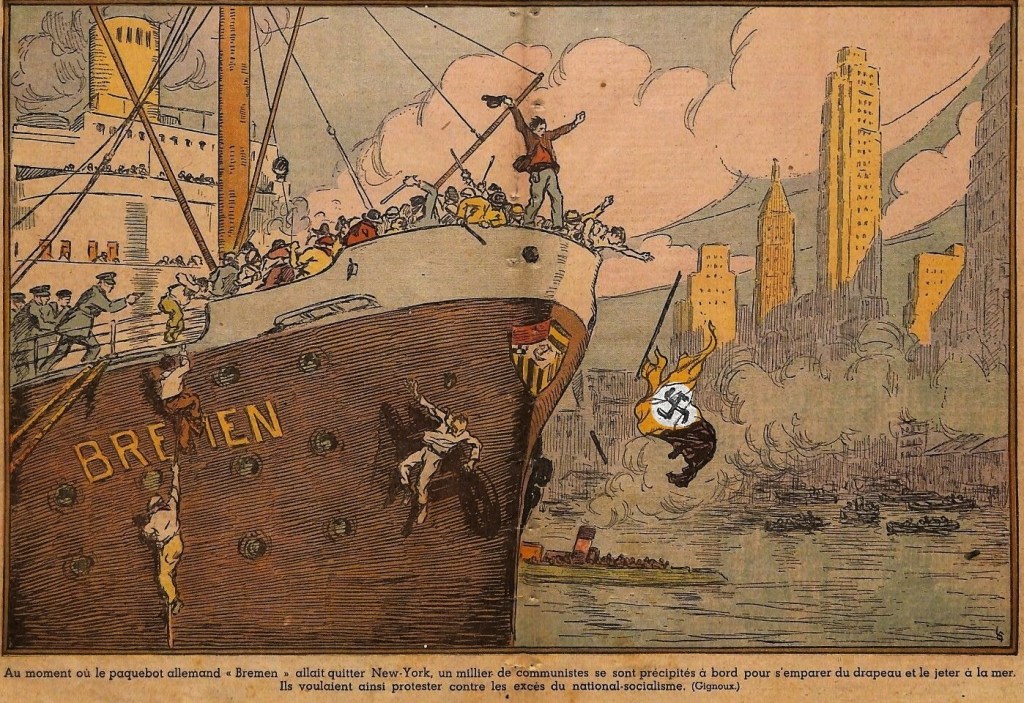
On 15 September 1935, the swastika flag became the national flag and ensign of Germany, replacing the black-white-red Imperial-era tricolour. The change came just over a year after the death of Reich President Paul von Hindenburg and reflected the Nazis’ increasingly complete transformation of Germany into a one-party dictatorship.
There may also have been a more immediate reason for the change. On 26 July 1935, during the so-called Bremen incident in New York, a group of demonstrators boarded the German ocean liner SS Bremen, tore the Nazi Party flag from its jackstaff and threw it into the Hudson River.
When the German government protested, American officials pointed out that the swastika flag was, at that time, officially a party flag rather than Germany’s national flag. Consequently, the demonstrators could not be prosecuted for damaging the German national flag, since legally they had only damaged the emblem of a political organisation.
The incident highlighted an awkward distinction for Nazi Germany. The swastika had become the most recognisable symbol of the regime, yet it was not technically the national flag. On 15 September, that distinction disappeared.
From that day forward, the swastika was no longer merely the symbol of the Nazi Party. It had become the official symbol of the German state.
Its constant presence helped make Nazi ideology part of the visual landscape of everyday life. A person did not have to attend a Nazi rally to encounter the regime’s propaganda; its symbols were displayed throughout public spaces.
The Nazi leadership also incorporated the swastika into ceremonies, architecture, uniforms and mass gatherings. This created a visual environment in which the regime appeared powerful and omnipresent.
For many Germans, the flag could represent national revival, political radicalism or support for Hitler. For those persecuted by the regime, however, it represented exclusion, fear and the destruction of the democratic state.
After the outbreak of the Second World War, the swastika became increasingly associated internationally with Nazi aggression. It flew over territories conquered by German forces and appeared on military and government buildings throughout occupied Europe. For millions who suffered under Nazi rule, the symbol became inseparable from persecution, war and genocide.
The Nazi flag therefore reflected the wider transformation of Germany between 1933 and 1935. A symbol once used by a political movement had become an official emblem of the state, displayed throughout German society as the regime dismantled democracy and imposed its racial ideology.
Sources
https://en.wikipedia.org/wiki/Flag_of_Nazi_Germany


Leave a comment