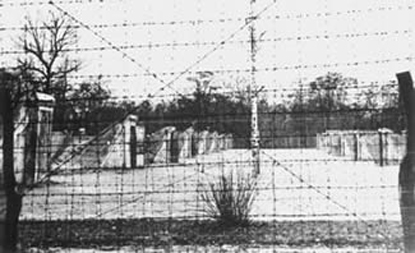
As Nazi forces prepared to retreat from Kyiv in the autumn of 1943, they attempted to conceal the evidence of the atrocities they had committed at Babi Yar. The ravine had become one of the most infamous killing sites of the Holocaust, where tens of thousands of Jews and other victims had been murdered. Now, the Nazis sought to erase the physical traces of their crimes.
The operation was placed under the supervision of Paul Blobel, the SS officer who had directed the mass executions at Babi Yar two years earlier. As part of Sonderaktion 1005, a vast Nazi effort to exhume and destroy the bodies of those murdered in mass shootings, Blobel oversaw the systematic dismantling of the evidence.
For approximately six weeks, from August into September 1943, more than 300 prisoners at the nearby Syrets concentration camp were forced to exhume the corpses from the ravine. Chained together and working under constant guard, they dragged the bodies from the earth and fed them into enormous makeshift cremation pyres. The Nazis used gravestones taken from a nearby Jewish cemetery as foundations for the burning structures, stacking layers of wood and corpses upon them until the pyres rose to the height of a two-storey building.
The fires burned for days. When the bodies had been reduced to ash, the remains were scattered across nearby fields and farmland. The attempt to erase the dead extended even to the landscape itself. Local memories of those fields endured for generations, including claims that some Ukrainians remained reluctant to eat cabbages grown on land where the ashes had been scattered.
But the Nazis had made a fatal miscalculation. They had forced the men who knew the truth most intimately to carry out the work. These prisoners had seen the bodies unearthed, the pyres built, and the remains destroyed. They understood that their own lives would almost certainly be sacrificed once the operation was complete.
Among them, a group began secretly preparing to resist. They collected tools, scraps of metal, hammers and screwdrivers, concealing whatever might serve as a weapon. They picked locks using keys recovered from the bodies of the dead. Beneath the ash and soot, beneath the exhaustion and terror, a desperate plan began to take shape.
Historian Reuben Ainsztein later described the spirit of these men:
“In those half-naked men who reeked of putrefying flesh, whose bodies were eaten by scabies and covered with a layer of mud and soot, and of whose physical strength so little remained, there survived a spirit that defied everything that the Nazis’ New Order had done or could do to them. In the men whom the SS men saw only as walking corpses, there matured a determination that at least one of them must survive to tell the world about what happened in Babi Yar.”
The prisoners knew that survival was unlikely. They also knew that if they did nothing, the world might never hear their testimony.
On the night of 29 September 1943, as the Nazis prepared to dismantle the camp, the prisoners launched their revolt. Armed with whatever they had managed to conceal, they attacked the guards. Some fought with hammers and screwdrivers; others had nothing but their bare hands. In the confusion, a number of prisoners managed to break free.
Approximately fifteen men escaped. Among them was Vladimir Davydov, who would later testify about the atrocities at Babi Yar during the Nuremberg Trials. Other escapees included Fyodor Zavertanny, Jacob Kaper, Filip Vilkis, Leonid Kharash, I. Brodskiy, Leonid Kadomskiy, David Budnik, Fyodor Yershov, Jakov Steiuk, Semyon Berland and Vladimir Kotlyar.
The revolt was crushed. Once the Nazis had re-established control, the prisoners who remained in the camp were executed. Contemporary accounts differ on the precise number of inmates involved in the final stages of the operation, but the overwhelming majority of those forced to participate in the exhumations were murdered.
The men had been ordered to destroy the evidence of Nazi crimes. Instead, some of them became the evidence.
The Testimony of the Survivors
On 6 December 1943, one month after the Red Army recaptured Kyiv, Soviet authorities brought a group of Western journalists to Babi Yar. Among them were American correspondents Bill Downs and Bill Lawrence, who interviewed three Jewish prisoners of war held at the Syrets camp and forced to participate in the disposal of the bodies: Efim Vilkis, Leonid Ostrovsky and Vladimir Davidoff.
Vilkis described the terrible work imposed upon the prisoners. His account, published by Downs, conveyed the scale of the operation and the desperate revolt that followed:
“However, even more incredible was the actions taken by the Nazis between August 19 and September 28 last. Vilkis said that in the middle of August the SS mobilized a party of 100 Russian war prisoners, who were taken to the ravines. On Aug. 19 these men were ordered to disinter all the bodies in the ravine. The Germans meanwhile took a party to a nearby Jewish cemetery whence marble headstones were brought to Babii Yar to form the foundation of a huge funeral pyre. Atop the stones were piled a layer of wood and then a layer of bodies, and so on until the pyre was as high as a two-story house.”
Vilkis explained that approximately 1,500 bodies were burned during each operation, with each pyre requiring two nights and a day to consume its contents. The cremations continued for around forty days. By the end, the prisoners understood that they themselves would be next.
According to the account, the men were ordered to construct one final furnace, despite the fact that no bodies remained. They recognized its intended purpose. The furnace was not for the dead. It was for them.
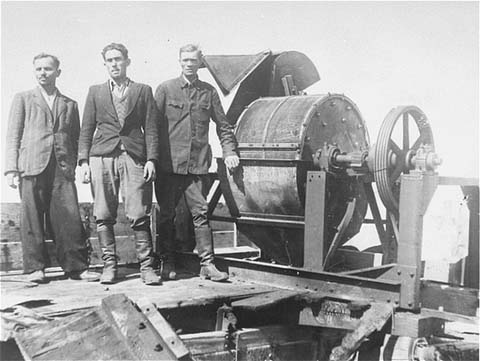
They decided to escape.
“They made a break but only a dozen out of more than 200 survived the bullets of the Nazi Tommy guns.”
The precise numbers in the contemporary journalistic account differ from those in other historical reconstructions, but the central truth remains unchanged: the prisoners staged a desperate revolt against a system designed to ensure that none of them would live to speak.
Vilkis also described the psychological and physical devastation inflicted upon the prisoners. Some became ill; others reportedly lost their sanity under the strain of the work. The SS killed several of those who could no longer continue, sometimes shooting three to five prisoners a day as a warning to the rest.
The Nazis had attempted to turn the prisoners into instruments of their own erasure. Instead, their suffering became a testament to the enormity of the crimes committed at Babi Yar.
After the Massacre
On 6 November 1943, the Red Army recaptured Kyiv. The Syrets concentration camp was subsequently converted into a Soviet detention camp for German prisoners of war, which remained in operation until 1946.
The camp was later demolished. During the 1950s and 1960s, urban development transformed the area, bringing apartment buildings and a park to the former site. Nearby construction projects also altered the landscape, and the Babi Yar ravine was eventually filled with industrial waste.

The physical traces of the massacre were progressively obscured beneath concrete, buildings and earth. Yet the attempt to erase the crime failed.
The Nazis could burn the bodies. They could scatter the ashes. They could dismantle the camp and reshape the ravine. But they could not entirely destroy the memory of what had happened there.
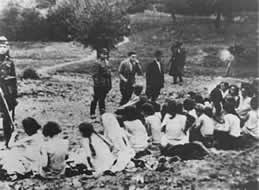
The prisoners of Sonderaktion 1005 had been condemned to disappear alongside the dead. Some escaped, carrying with them the knowledge of the killing ground and the names of those who had vanished into it. Their survival was more than an act of resistance. It was a refusal to allow the victims of Babi Yar to be murdered a second time—first in the ravine, and then in history.
Sources:
https://encyclopedia.ushmm.org/content/en/article/the-syrets-labor-education-camp
https://en.wikipedia.org/wiki/Syrets_concentration_camp
https://academic.oup.com/hgs/article-abstract/29/3/431/2384538
Donation
Your readership is what makes my site a success, and I am truly passionate about providing you with valuable content. I have been doing this at no cost and will continue to do so. Your voluntary donation of $2 or more, if you are able, would be a significant contribution to the continuation of my work. However, I fully understand if you’re not in a position to do so. Your support, in any form, is greatly appreciated. Thank you. To donate, click on the credit/debit card icon of the card you will use. If you want to donate more than $2, just add a higher number in the box left from the PayPal link. Your generosity is greatly appreciated. Many thanks.
$2.00


Leave a comment