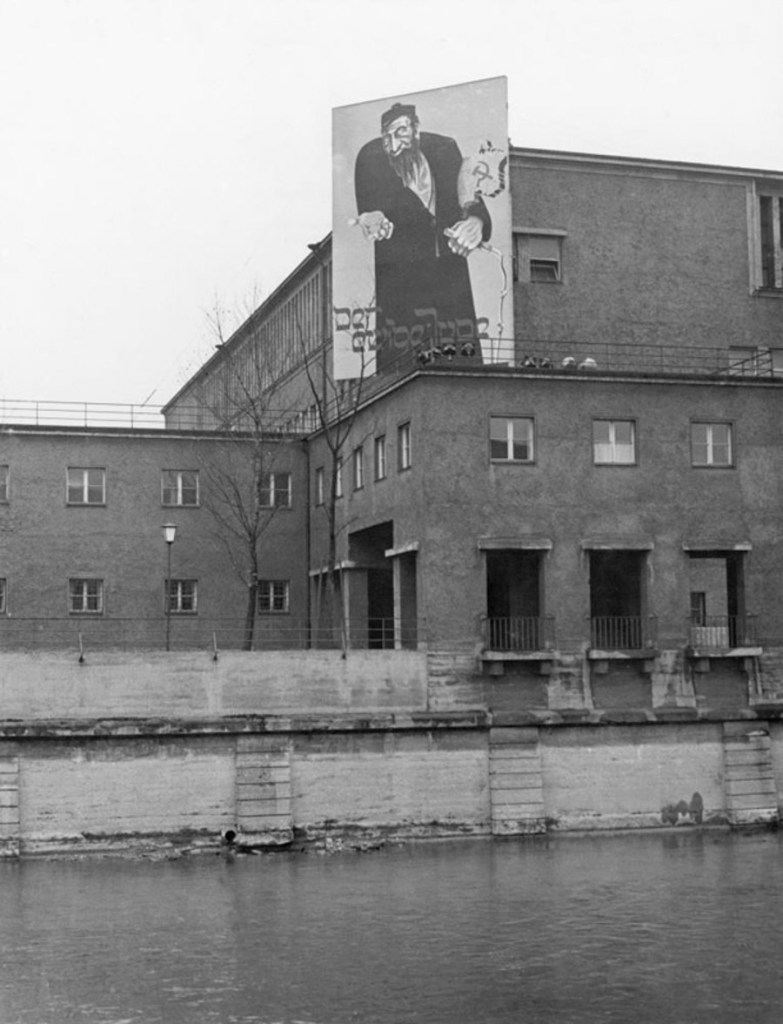
On November 8, 1937, one of the most notorious antisemitic propaganda exhibitions of Nazi Germany opened its doors at the Deutsches Museum in Munich. Entitled Der ewige Jude (The Eternal Jew), the exhibition was designed to do far more than present the Nazi regime’s distorted interpretation of Jewish history. It was an elaborate exercise in public humiliation, intimidation and incitement to hatred. Its purpose was to portray Jewish people as an existential threat to German society and to make their exclusion from that society appear justified.
By the time the exhibition closed on January 31, 1938, approximately 412,300 people had visited it. It subsequently travelled to several other German and Austrian cities, attracting more than 1.3 million visitors in total. These figures made it one of the most successful propaganda exhibitions organised by the Nazi regime.
But its success was not measured simply by the number of tickets sold. The exhibition formed part of a much wider campaign to condition German society to accept the persecution, dispossession and eventual destruction of its Jewish population.
The Road to the Exhibition
Since Adolf Hitler’s appointment as Chancellor in January 1933, German Jews had experienced an increasingly systematic campaign of discrimination and persecution. The boycott of Jewish businesses, the dismissal of Jewish civil servants, professional restrictions and the Nuremberg Laws of September 1935 had progressively stripped them of their rights as German citizens.
By 1937, antisemitism had become deeply embedded in the machinery of the Nazi state. Propaganda was no longer confined to newspapers, speeches and radio broadcasts. The regime increasingly used exhibitions to turn ideological hatred into something tangible, something people could walk through, observe and supposedly experience for themselves.
The Nazis had already organised large exhibitions attacking Bolshevism and what they described as the enemies of the German nation. The exhibition The Eternal Jew represented the culmination of these efforts, bringing together almost every antisemitic conspiracy theory and racial stereotype developed by Nazi propagandists.
The organisers wanted visitors to leave with one overriding impression: that Jews were not simply a religious or ethnic minority but a dangerous, alien force supposedly operating against Germany and the wider world.
The Men Behind the Exhibition
The exhibition opened on November 8, 1937, in the Congress Hall of the Deutsches Museum in Munich. The opening ceremony was attended by senior Nazi officials and included speeches by Propaganda Minister Joseph Goebbels and Julius Streicher, the fanatical antisemitic publisher of the newspaper Der Stürmer.
Its organisation involved several Nazi institutions, including the Reich Ministry of Propaganda, the Munich-Upper Bavaria regional propaganda office and organisations devoted to the regime’s so-called study of the Jewish question.
Among those involved were the Anti-Comintern, the Institute for the Study of the Jewish Question, the SS Main Security Office and the central publishing house of the Nazi Party.
The exhibition was directed under the supervision of Walther Wüster, deputy Gau propaganda leader, with Fritz von Valtier and graphic artist Horst Schlüter among the principal figures responsible for its organisation and visual presentation.
This was not the work of a handful of fanatics operating on the fringes of German society. It was a coordinated undertaking involving the propaganda apparatus of the Nazi state.
The title itself, The Eternal Jew, drew upon an old European antisemitic stereotype. Its origins lay partly in the Christian legend of the Wandering Jew, a figure condemned to wander endlessly. Nazi propaganda appropriated this image and transformed it into a racial conspiracy narrative, portraying Jews as permanently alien, rootless and incapable of belonging to any nation.
A Journey Through Hatred
The exhibition occupied approximately twenty rooms on the upper floor of the Deutsches Museum’s library building. Its design was deliberately theatrical. Every room, photograph, display case and lighting arrangement was intended to provoke an emotional reaction.
The organisers understood that propaganda did not necessarily have to persuade through facts or logical argument. It could also manipulate through fear, disgust, humiliation and spectacle.
The first room set the tone. Visitors encountered photographs of Jewish public figures, including politicians, intellectuals and cultural personalities. Beneath these images were enlarged representations of supposedly characteristic Jewish facial features, including noses and mouths, alongside three wax models of male heads.
The models were reportedly based on concentration camp prisoners.
The intention was to present racial classification as scientific fact. Yet the contradictions were obvious. When the physical characteristics displayed did not correspond to the photographs of the individuals above them, the exhibition simply suggested that Jews deliberately concealed their supposed racial identity.
In other words, the propaganda was constructed so that no evidence could disprove it.
A long corridor followed, presenting a distorted account of Jewish history and religion, from antiquity to the twentieth century. Religious objects, historical documents and cultural artefacts were arranged alongside deliberately misleading explanations and fabricated interpretations.
One particularly disturbing feature was a film showing the slaughter of an animal according to Jewish religious practice. The footage had been filmed in an exceptionally brutal manner to maximise its emotional impact.
Visitors were encouraged to associate the images with the antisemitic blood-libel myth, the centuries-old false accusation that Jews murdered Christians for ritual purposes.
A Czech journalist, Eugen V. Erdely, who visited the exhibition in December 1937, described how visitors reacted with disgust to the footage. He also recorded the comments of an exhibition guide who suggested, without evidence, that Jews might also be required by their religion to murder human beings.
This was not historical education. It was the deliberate manufacture of hatred.
The Jewish Contribution to German Culture on Trial
Other sections concentrated on Jewish participation in German and European cultural life, particularly during the Weimar Republic.
The exhibition presented Jewish contributions to literature, music, theatre, film, medicine, science and the arts as evidence of an alleged Jewish domination of German society.
Among the people singled out for ridicule and defamation were writers Arthur Schnitzler and Franz Werfel, composer and conductor Richard Tauber, violinist Yehudi Menuhin, artist Max Liebermann, psychologist Sigmund Freud and sexologist Magnus Hirschfeld.
The actress Elisabeth Bergner and numerous other prominent figures were also included.
Their achievements were not acknowledged. Instead, they were presented as evidence of an imagined conspiracy.
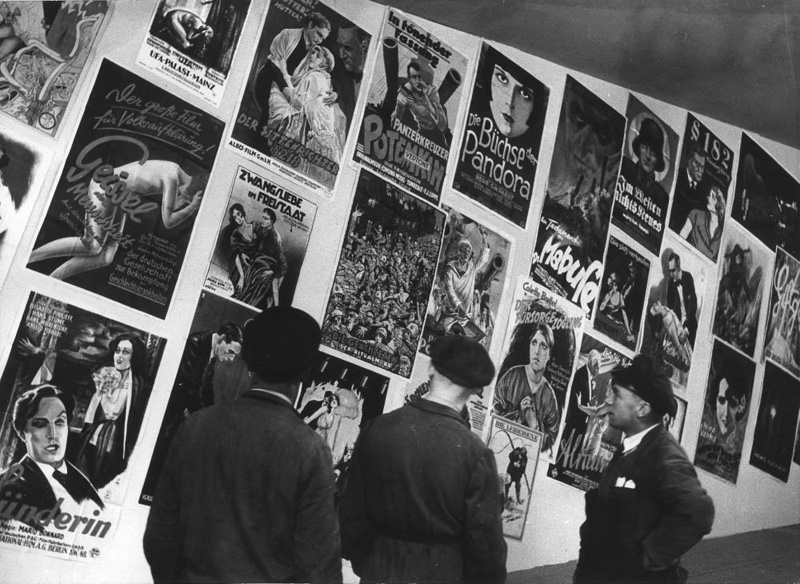
A section devoted to Jewish involvement in the cultural life of the 1920s portrayed the artistic and intellectual freedom of the Weimar Republic as a form of moral degeneracy. Film posters were selected for their supposedly scandalous titles, while photographs and other material were arranged to suggest sexual immorality and social corruption.
The exhibition even included a cinema.
There, visitors were shown a roughly 36-minute compilation entitled Juden ohne Maske (Jews Without a Mask), assembled from scenes taken out of context from various German films. The intention was to associate Jewish actors and cultural figures with criminality, immorality and social disorder.
The manipulation was deliberate. Images that had originally belonged to entirely different stories were edited together to create a false narrative.
The technique would later be developed further in the notorious 1940 Nazi propaganda film Der ewige Jude, which carried the same title as the exhibition.
Manufacturing an Enemy
Another section concentrated on the alleged connection between Judaism and Bolshevism.
The Nazis had long promoted the conspiracy theory of so-called Jewish Bolshevism, claiming that Jews were responsible for communism and revolutionary movements. The exhibition used disturbing images of violence, destruction and political upheaval to reinforce this association.
Freemasonry was also incorporated into the conspiracy narrative. Nazi propaganda portrayed Jewish people and Freemasons as partners in an imagined international plot to control the world.
One room contained a reconstructed Masonic ceremonial hall, complete with a crypt, coffins, skeletons and skulls. The deliberately dark atmosphere was intended to frighten visitors and associate Freemasonry with sinister Jewish influence.
The exhibition’s visual techniques were remarkably sophisticated. Walls appeared to tilt forward, corridors were constructed to create a sense of oppression, and oversized photomontages confronted visitors with grotesquely distorted images.
Lighting, colours, sound and architectural design were all employed to create a continuous atmosphere of menace.
The Nazi newspaper Völkischer Beobachter openly described the intention behind this approach. In January 1938, it explained that a political exhibition designed to influence visitors had to shock them, disturb them and continually stimulate their attention.
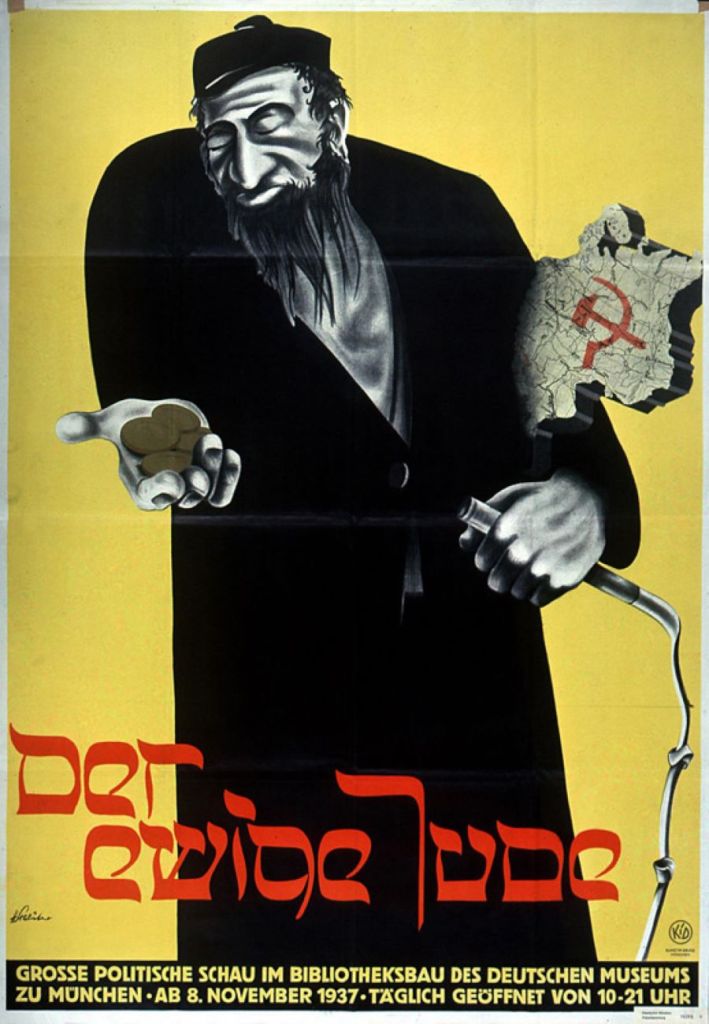
Even Goebbels was dissatisfied with the original presentation. In his diary entry of November 9, 1937, he complained that the exhibition was too academic, contained too much material and needed to be shortened and better organised.
The objective was not to educate visitors about Jewish history. It was to make them feel that they had witnessed overwhelming evidence of a threat.
A Public Spectacle of Exclusion
The final sections of the exhibition made the political message unmistakable.
The Nazis presented themselves as the heroic force supposedly rescuing Germany from Jewish influence. Large posters from the early years of the Nazi movement and displays of Nazi literature reinforced the contrast between the idealised image of the so-called German national community and those excluded from it.
One of the final rooms referred directly to the contemporary situation of Jews in Germany. Concentration camps and the exclusion of Jews from German society were presented not as acts of persecution but as supposedly necessary measures to solve what the Nazis called the Jewish question.
The exhibition therefore did something particularly sinister. It connected fabricated accusations about Jewish history and culture with the very real persecution taking place outside its walls.
Visitors were invited to regard the deprivation of Jewish rights and freedoms as a legitimate response to the imaginary threat they had just been shown.
The Reaction: Not Everyone Was Convinced
Although the exhibition received extensive coverage in the German press, not all international observers accepted its claims.
Newspapers in Britain, the United States, the Netherlands, Austria and Czechoslovakia criticised the exhibition and exposed its distortions.
The New York Times reported on its opening, while the British Times noted that prominent Jewish figures who had contributed enormously to Germany’s reputation and to humanity were being publicly vilified.
The Austrian newspaper Neue Freie Presse described the exhibition as an unnecessary collection of old and unfounded accusations, serving incitement rather than any attempt at objective argument.
The Neue Wiener Tagblatt went further, describing it as an invitation to a pogrom issued from above.
One of the most valuable contemporary accounts came from Eugen V. Erdely, whose detailed report appeared in the Czechoslovak weekly Přítomnost on December 22, 1937. His observations exposed the absurdities, contradictions and calculated cruelty of the exhibition.
An American visitor, Roy E. B. Bower, also recognised an unintended consequence of the displays. He suggested that, rather than diminishing Jewish achievements, the exhibition frequently demonstrated the extraordinary intellectual and cultural contributions of Jewish people.
Yet he also warned that the exhibition could strengthen existing fears of Jewish competition and convince previously indifferent Germans that Jews were foreign enemies within their own country.
That was perhaps the most dangerous aspect of the entire undertaking. Even when the propaganda failed to convince visitors of its specific accusations, it could still reinforce the idea that Jews did not belong.
A Different Response: Irene Harand
There was at least one notable act of resistance specifically directed against the exhibition.
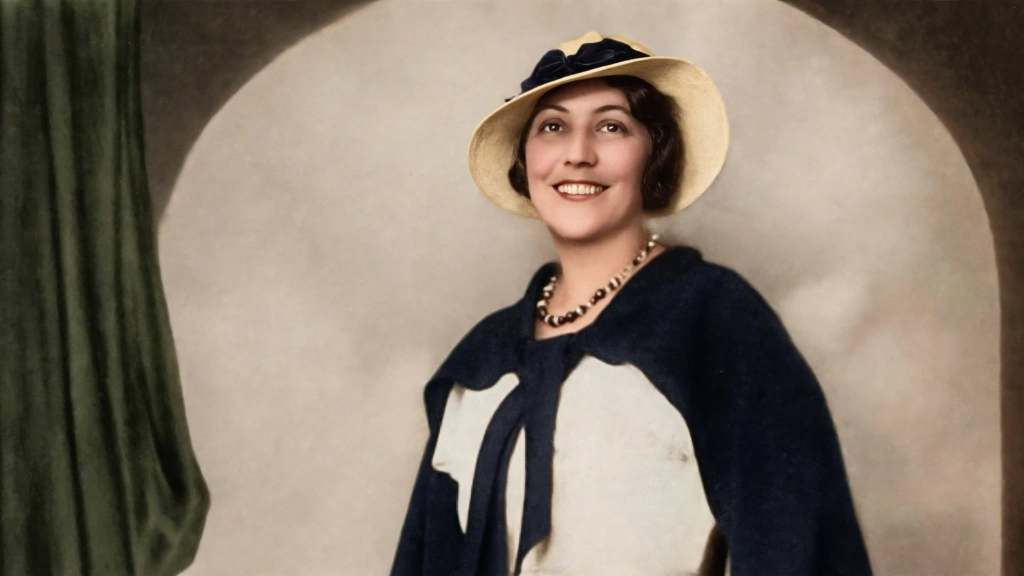
The Austrian writer and anti-Nazi activist Irene Harand, who had long campaigned against racial hatred, responded by launching what became known as her stamp campaign.
Harand was born in Vienna in 1900 and raised as a Roman Catholic. Her opposition to antisemitism began at an early age, influenced in part by her experiences with two Jewish half-cousins. Through them, she became aware of the prejudice and discrimination directed against Jewish people.
In 1933, as the Nazi movement gained influence in Germany and antisemitism spread across Europe, Harand established the Weltbewegung gegen Rassenhass und Menschennot (World Movement Against Racial Hatred and Human Suffering), also known as the Harand Movement. The organisation campaigned internationally against racial persecution and Nazi antisemitism.
She produced a series of stamps commemorating the achievements of Jewish personalities who had made lasting contributions to science, literature and culture.
Among those honoured were Nobel Prize-winning scientist Paul Ehrlich, writer Heinrich Heine and composer Giacomo Meyerbeer.
The stamps were intended for international distribution through the postal system. German authorities refused to deliver letters bearing them.
Harand’s response was simple but meaningful. Where the Nazi exhibition attempted to reduce Jewish people to grotesque caricatures, she presented their actual achievements and reminded the world of their humanity.
It was an attempt to answer hatred with historical truth.
The Audience and the Consequences
The exhibition attracted people from virtually every section of German society. Nazi Party members, military personnel, factory workers, school groups and ordinary visitors attended. Some arrived in organised groups, travelling to Munich by special trains and buses.
Not everyone necessarily attended because they believed the propaganda. Some came out of curiosity, others because attendance was encouraged or expected, while some were simply attracted by the spectacle.
However, curiosity and indifference were not harmless in this context.
The exhibition offered visitors an opportunity to indulge in the grotesque, to stare at people who had been deliberately presented as inferior, dangerous and alien. It transformed antisemitic prejudice into a form of public entertainment.
Even political opponents of the regime and Jewish visitors themselves entered the exhibition, perhaps to witness the extent of the hatred directed against them.
The fact that more than 400,000 people visited the Munich exhibition alone is a reminder of the enormous reach of Nazi propaganda. It does not mean that every visitor accepted everything they saw, nor that all Germans shared the same beliefs. But it demonstrates how successfully the regime could turn hatred into a mass public event.
By the time the exhibition closed in Munich on January 31, 1938, the machinery of persecution was already moving towards a new and more radical phase.
The Anschluss, the annexation of Austria, followed in March 1938. Jewish property was increasingly confiscated, Jewish businesses were destroyed or forcibly transferred, and the remaining rights of Jewish citizens were systematically dismantled. The November Pogrom of November 9–10, 1938, would bring an unprecedented escalation of open violence.
The exhibition had not caused these developments by itself. It was one component of a much larger system of propaganda, legislation, intimidation and state-sponsored violence.
But it helped prepare the ground.
More than 1.3 million people would eventually visit The Eternal Jew in its various locations. They were shown fabricated evidence, manipulated photographs, distorted history and carefully staged images designed to make an entire population appear unworthy of dignity and protection.
There is something particularly chilling about the fact that this exhibition took place in a museum, an institution normally associated with knowledge, learning and the preservation of history.
The Nazis had taken a place of learning and turned it into a theatre of hatred.
And perhaps that is the most important lesson of The Eternal Jew. Dehumanisation does not always begin with violence. Sometimes it begins with an exhibition, a photograph, a misleading caption or a carefully constructed narrative that teaches people to look at their neighbours differently.
By the time the violence becomes impossible to ignore, the process of making its victims appear less than human may already have been underway for years.
Sources:
https://de.wikipedia.org/wiki/Der_ewige_Jude_(Ausstellung)
https://www.historisches-lexikon-bayerns.de/Lexikon/Der_Ewige_Jude_(Ausstellung,_1937)


Leave a Reply