I have written several blogs on Westerbork. The reasons I highlight Westerbork are:
- It was the place where most Dutch Jewish and Jewish Refugees passed through before being sent to extermination camps.
- It had initially been set up as a refugee centre for Jews prior to the war.
- Although the death toll was much lower in Westerbork than in other camps, it was also one of the most sinister camps.
It is the sinister aspect I want to explore here. The biggest crime committed in Westerbork was it gave those imprisoned— hope, or rather, false hope. It was a distraction from their awaited fate.
The Dutch government established a camp at Westerbork in 1939 to intern Jewish refugees, the majority from Germany. The first refugees arrived in Westerbork in October of that year. In April 1940, there were approximately 750 Jewish refugees housed in the camp. Some were German Jews who had been passengers on the MS St. Louis.
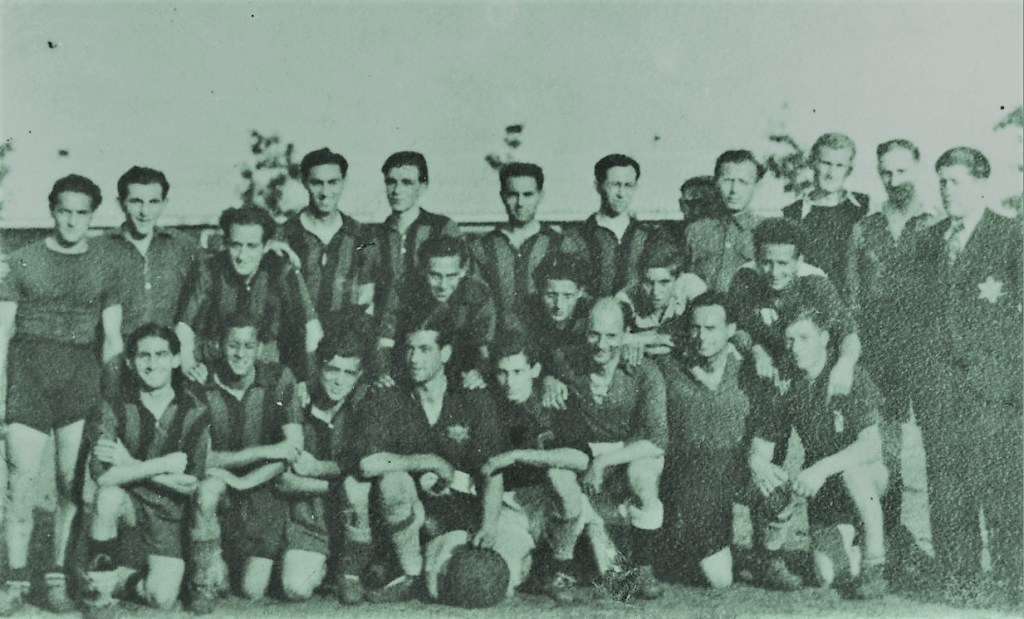
The photograph above is of the camp’s football team. Amidst all the killing, torture, deportations and other horrors in Camp Westerbork, they actually found time to set up a football competition.
Some prisoners were well-known European players or players from major European teams.
Westerbork had facilities like a hospital, an orphanage with a playground, and a football competition that fell into that category. The prisoners got hope and a sense of normality out of this.
How did the idea of a football competition come from? In 1943, a small group of prisoners went from Westerbork to Amsterdam—where they had to work in a factory. Whilst on the train from Assen to Amsterdam, they read a paper, De Telegraaf, a widespread Dutch Newspaper. The newspaper had an article that the national football competition was still going. When reading this news, one of the group members got angry; they were playing without him! How could this be?
Within that group that travelled to Amsterdam were multiple footballers, such as Ignatz Feldmann, a famous professional footballer from Austria in the 1920s and the 1930s.
Feldman was one of the best defenders at that time. He was well-known—not only in Austria but also in The Netherlands—and had a certain status within Camp Westerbork and the Jewish community. During that train journey from Assen to Amsterdam, he came up with the idea of starting a football competition at the camp. The camp commandant allowed it.
It was quite a professional-looking competition. With matches being played every week.
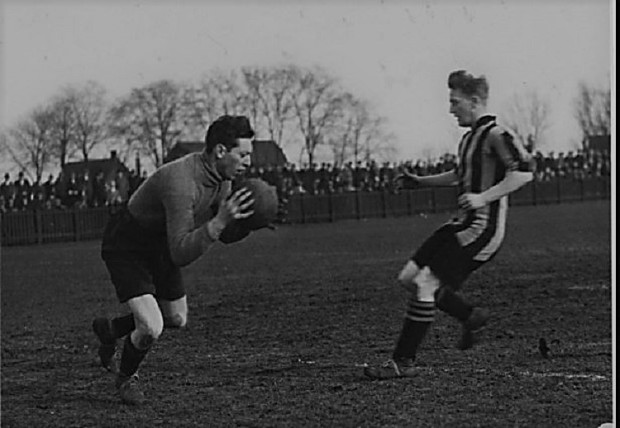
Eddy Hamel was an American Jew who played for AFC Ajax, Amsterdam. Ernst Alexander was a Jewish player for FC Schalke 04, and Árpád Weisz was a Hungarian Olympic football player and manager. He was managing FC Dordrecht in the Netherlands when the war broke out. They all were murdered in Auschwitz.
Football was not the only thing that distracted the prisoners from their fate. There were factories, music, and playgrounds, It was nearly like an ordinary town.
Camp Westerbork also had a school, orchestra, hairdresser, and even restaurants designed by SS officials to give inmates a false sense of hope for survival and to aid in avoiding problems during transportation.
The camp administration was headed by a German commandant. Westerbork had three commandants, all of whom were SS officers: Erich Deppner (July 1942–September 1942); Josef Hugo Dischner (September–October 1942); and Albert Konrad Gemmeker (October 1942–April 1945). German SS men and a rotating group of Dutch civilian and military police guarded the camp. In addition to the German and Dutch personnel, a Jewish police force, called the Ordedienst or the OD, kept order in the camp.
Below is a film that shows what life in Westerbork was like. It was recently discovered and restored. It is a long film—but it is well worth the watch.
Sources
https://schalke04.de/verein/schalke-hilft/handlungsfelder/stehtauf/ernst-alexander-auszeichnung/
Football at the Concentration Camp

Donation
Your readership is what makes my site a success, and I am truly passionate about providing you with valuable content. I have been doing this at no cost and will continue to do so. Your voluntary donation of $2 or more, if you are able, would be a significant contribution to the continuation of my work. However, I fully understand if you’re not in a position to do so. Your support, in any form, is greatly appreciated. Thank you. To donate, click on the credit/debit card icon of the card you will use. If you want to donate more than $2, just add a higher number in the box left from the PayPal link. Your generosity is greatly appreciated. Many thanks.
$2.00

 History of Sorts
Leave a comment