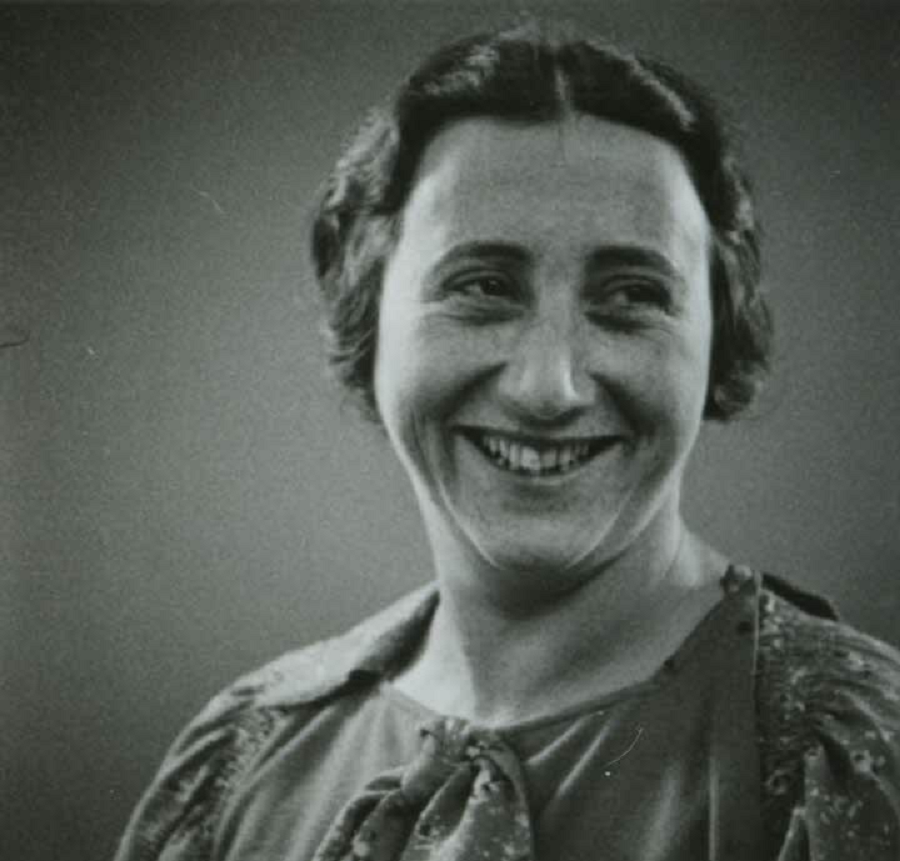
Anne Frank’s diary remains one of the most significant and poignant records of the Holocaust, providing an intimate glimpse into the lives of those forced into hiding under the oppressive rule of Nazi Germany. However, while Anne’s voice is immortalized in her writings, the other individuals who shared her confinement in the secret annex in Amsterdam are often overlooked. Among them was Edith Frank, Anne’s mother, a woman who endured immense hardship and displayed remarkable strength and sacrifice until her final moments.
Edith Frank, born Edith Holländer on January 16, 1900, was the youngest of four children in a well-established German Jewish family in Aachen, Germany. Her father, Abraham Holländer, was a prosperous businessman in industrial equipment and an active member of the local Jewish community, along with her mother, Rosa Stern. Edith had two older brothers, Julius and Walter, and an older sister, Bettina, who tragically passed away at the age of 16 from appendicitis when Edith was just 14.
In 1924, Edith met Otto Frank, and the couple married on his 36th birthday, May 12, 1925, at the synagogue in Aachen.

Their union was one of love and partnership, and together they built a life in Frankfurt, Germany, where they welcomed two daughters: Margot, born on February 16, 1926, and Anne, born on June 12, 1929. However, their peaceful family life was soon upended by the rise of antisemitism and the implementation of discriminatory laws against Jews in Nazi Germany.
Realizing the increasing dangers, the Franks made the difficult decision to leave their homeland, emigrating to Amsterdam in 1933. There, Otto established a branch of his spice and pectin distribution company. Opekta.

While Otto worked to rebuild their lives, Edith took on the role of caring for their children and supporting their education. Meanwhile, her brothers Walter and Julius managed to escape to the United States in 1938, and her mother, Rosa, joined the family in Amsterdam in 1939.
However, their refuge was short-lived. In May 1940, the Nazis invaded the Netherlands, and the persecution of Jews began. Jewish children, including Margot and Anne, were expelled from their schools, and Otto was forced to relinquish ownership of his business. By 1942, the danger had become too great, and the family went into hiding in the now-famous secret annex at Prinsengracht 263. They were joined by Hermann, Auguste, and Peter van Pels, as well as Fritz Pfeffer, a dentist and acquaintance of the family.
For two years, the eight individuals lived in close quarters, relying on the help of trusted friends, including Miep Gies, Johannes Kleiman, Victor Kugler, and others who risked their lives to bring them food and news from the outside world. Edith struggled emotionally during this period, often feeling a deep sense of despair. Miep Gies later recounted a private conversation with her in which Edith admitted to losing hope while others held onto dreams of liberation. Despite this internal struggle, Edith remained devoted to her daughters, prioritizing their well-being above all else.
Tragically, on August 4, 1944, the annex was raided following a betrayal by an unknown informant. The Franks and their companions were arrested and taken to the Gestapo headquarters on Euterpestraat before being imprisoned at the Amstelveenseweg detention center. Three days later, they were transported to Westerbork, a transit camp in the Netherlands, where they endured grueling forced labor.
On September 3, 1944, the family was deported on the last transport to Auschwitz. Upon arrival, Otto was separated from Edith and their daughters, never to see them again. On October 30, Edith was further separated from Anne and Margot during a selection process. While her daughters were sent to Bergen-Belsen, Edith remained in Auschwitz, where she displayed extraordinary maternal sacrifice. She hoarded whatever scraps of food she could find, saving them in the hope of providing for her daughters upon their return.
Edith’s devotion came at a terrible cost. Due to extreme malnutrition and the harsh winter conditions, she succumbed to starvation on January 6, 1945—just three weeks before the Red Army liberated Auschwitz and ten days before what would have been her 45th birthday. Unbeknownst to her, Margot and Anne had already been transferred to Bergen-Belsen, where they tragically perished from disease and starvation in February or March 1945.
Though often overshadowed by her daughter Anne’s legacy, Edith Frank’s story is one of profound love, resilience, and sacrifice. She endured unimaginable suffering, holding onto hope for her family until the very end. Her life, like so many others, was cut short by the horrors of the Holocaust, yet her devotion as a mother and the sacrifices she made remain an enduring testament to the human spirit.
Sources
https://www.bbc.co.uk/annefrank/biogs/edithfrank.shtml
https://www.annefrank.org/en/anne-frank/main-characters/edith-frank/
https://research.annefrank.org/en/personen/5166e05f-5950-486d-bb13-160b2a586fd5/
https://en.wikipedia.org/wiki/Edith_Frank
Please support us so we can continue our important work.
Donation
Your readership is what makes my site a success, and I am truly passionate about providing you with valuable content. I have been doing this at no cost and will continue to do so. Your voluntary donation of $2 or more, if you are able, would be a significant contribution to the continuation of my work. However, I fully understand if you’re not in a position to do so. Your support, in any form, is greatly appreciated. Thank you. To donate, click on the credit/debit card icon of the card you will use. If you want to donate more than $2, just add a higher number in the box left from the PayPal link. Your generosity is greatly appreciated. Many thanks.
$2.00

 History of Sorts
Leave a comment