
On February 25, 1941, the Dutch decided that enough was enough. No longer would they stand idly by to see the treatment of their Jewish neighbors.
The first 8 months of the Nazi occupation did not see that much change to the Dutch. The changes were all gradual. However, there were increased tensions. The WA(Weerbaarheidsafdeling-defense section), the para-military arm of the Dutch Nazi party NSB, was actively involved in provocative and intimidating actions in Jewish areas in Amsterdam resulted in one of the members of the WA, Hendrik Koot, being killed by a local resistance group in Amsterdam on February 11, 1941.

The day after, on February 12, 1941, German soldiers assisted by Dutch police besieged the old Jewish quarter. They blocked it off from the rest of the city by putting up barbed wire fences, opening draw bridges, and erecting police checkpoints, and they forbade non-Jews to the neighborhood.

A week later, on February 19, the German Grüne Polizei stormed into the Koco ice cream salon, which Ernst Cahn and Alfred Kohn owned; both were Jewish refugees who had fled Germany. A fight ensued, and some ammonia gas escaped in the incident, and several police officers were injured.
The head of the SS in the Netherlands, Hanns Albin Rauter. reported the incident to Heinrich Himmler on February 20 and indicated that the two men, Cahn and Kohn, had willfully attacked the police officers.
The death of Hendrik Koot and the incident at the ice cream salon gave the excuse to initiate the first raids on Jews in the Netherlands on February 22 and 23, 1941.
427 Jewish men, aged 20-35, were arrested and sent to Kamp Schoorl.


Most of them were deported and eventually sent to the Mauthausen concentration camp; the majority of them died within the year, and only 2 survived.
Ernst Cahn was executed on March 3,1941, and Alfred Kohn died in Auschwitz.
Following this raid, the Communist Party of the Netherlands called for action on February 24, during an open-air meeting they did this at their own peril because the party had been made illegal by the Nazi occupiers. Nonetheless, they organized a strike to be held on February 25 and 26, 1941, in Amsterdam as a protest against the pogrom and also the forced labor in Germany.
The Dutch population listened to the call for strike and about 300,000 workers did go on strike.
On Tuesday, February 25, tram drivers and sanitation workers started it. Followed quickly by dockworkers. Workers on bicycles rang the doorbells at homes and halted traffic in the streets, imploring drivers to join them.
Rauter ordered harsh actions against the strikers and orders SS troops to shoot, 9 people were killed. The strike initially started in Amsterdam, but the following day, workers were in Hilversum, Zaandam, Haarlem, and Utrecht.
Additionally to the nine people killed during the strike, another 24 were injured. On March 13, 1941, the Nazis executed three of the organizers. Ironically, those three actually saved three minors who were members of a group of 18 of the resistance group “De Geuzen,” because of their young age, the SS changed their death sentences to life imprisonment.
The Nazis decided to execute Hermanus Coenradi, Joseph Eijl, en Eduard Hellendoorn, who were three of the organizers of the February strike, instead, together with the other 15 of De Geuzen.
The Nazi regime finally showed its real face to the Dutch.
The strike was the first and only direct action against the Nazis’ treatment of Jews in Europe.
This monument, “De Dokwerker,” the Dockworker, is dedicated to the strikers of the February strike. It is situated on Jonas Daniël Meijerplein, the square where most of the 427 Jewish men were arrested.
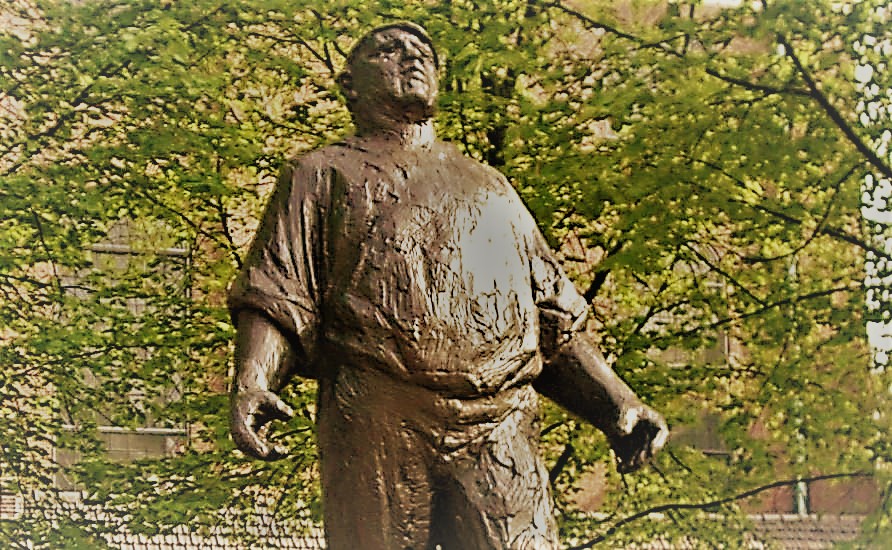
February 25, 1941, the day when the Dutch said, “Enough is enough.” Unfortunately, despite the brave efforts and the sacrifice of those who were killed for it, it did not stop the murder of 104,000 Dutch Jews.
Sources
https://web.archive.org/web/20110929140015/http://www.joodsmonument.nl/page/274192
Februaristaking (1941) – Protest tegen de Jodenvervolging
https://www.nationalww2museum.org/war/articles/amsterdam-general-strike-february-1941
https://www.npostart.nl/2doc/22-02-2016/KN_1678989
Please support us so we can continue our important work.
Donation
Your readership is what makes my site a success, and I am truly passionate about providing you with valuable content. I have been doing this at no cost and will continue to do so. Your voluntary donation of $2 or more, if you are able, would be a significant contribution to the continuation of my work. However, I fully understand if you’re not in a position to do so. Your support, in any form, is greatly appreciated. Thank you. To donate, click on the credit/debit card icon of the card you will use. If you want to donate more than $2, just add a higher number in the box left from the PayPal link. Your generosity is greatly appreciated. Many thanks.
$2.00
 History of Sorts
Leave a comment