The term ‘work extension’ was a euphemistic term for the actual goal of the deportations: to work to death those who were healthy enough to work and to murder all others. At least 102,000 Jewish Dutch people were murdered or died from exhaustion and diseases.
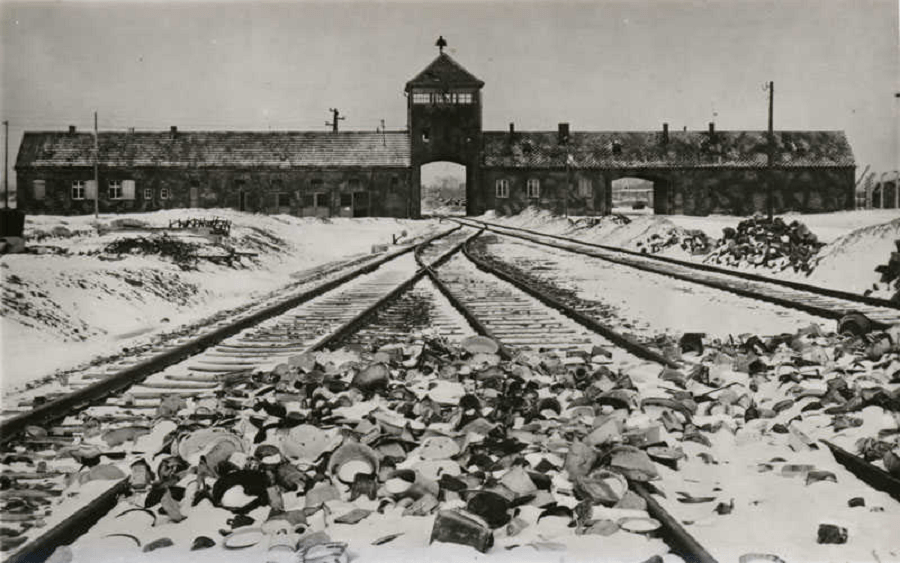
Auschwitz-Birkenau
It is not exactly known when the Nazis decided to murder all European Jews, after emigration had initially been the goal, but it must have been sometime in the autumn of 1941. After the necessary preparations, including the Wannsee Conference where the logistics of mass murder were discussed, the deportations from Western Europe began in July 1942. The first Dutch transport left on July 16th for Auschwitz. A total of 64 transports would follow.
Auschwitz was the destination for most of the transports. In the spring of 1942, two provisional gas chambers were set up in old farms located within the new Birkenau camp. This camp became the main site for the mass murder, and most Dutch Jews were killed there. In 1943, four new gas chambers with crematoria were built in the camp, each with a capacity of 1,200 to 1,500 people, where 120,000 people per month were murdered and their bodies burned.
Selections
Dutch Jews arrived at a platform located at the freight station of Oświęcim (Auschwitz). There, selections were also made by one of the SS doctors. They immediately sent all elderly people and mothers with young children to the gas chambers. Men and women without children, between the ages of 15 and 55, were spared for the moment and registered as Häftlinge (prisoners) in the camp. They were also tattooed with the infamous camp number on their arms. The others were sent on foot, or by truck, to one of the gas chambers. There, they were murdered and their bodies burned. Their belongings were sorted and stored by other prisoners in a section of the camp called Kanada. These belongings were then sent to Germany.
Prisoners who were forced to work were, after a quarantine period, assigned to a work detail or sent to one of the satellite camps. The duration of their survival depended on the severity of the work, but it was certain that the chance of survival was very small. Moreover, selections also took place in the barracks and at the daily roll call, where the weakest were sent to the gas chambers. Ultimately, fewer than 900 Jews returned from Auschwitz to the Netherlands.
Sobibor
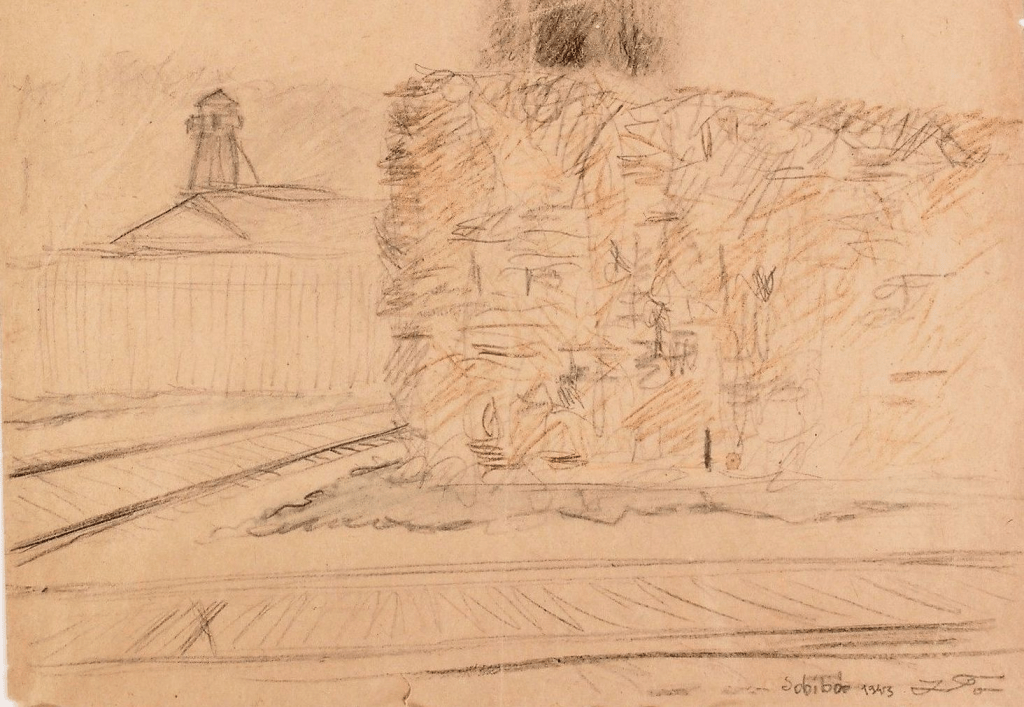
In 1943, 19 deportation trains left Westerbork for Sobibor instead of Auschwitz. Auschwitz had become ‘overcrowded’ with the murder of Jews from Thessaloniki. Later, a typhus epidemic broke out in the camp, which led the SS to refuse new transports. Sobibor was one of the camps of the so-called Aktion Reinhardt, the camps that were established to murder Jews from the General Government (Eastern Poland) and parts of Western Ukraine. In Sobibor, no selections were made; more than 99% of those who arrived were murdered immediately upon arrival. The camp was also small, measuring 400 by 600 meters. The areas where the gas chambers were located were strictly separated from other parts of the camp where forced laborers were kept, and from the SS camp. 34,313 Dutch Jews were murdered in the gas chambers there.
There are 19 known Dutch survivors from this camp. The most famous is Jules Schelvis, who was selected for forced labor at the Dorohucza camp near Lublin upon arrival. He had been in the camp for only a few hours. Selma Wijnberg, also Dutch, survived the legendary uprising at Sobibor. On October 14, 1943, the majority of prisoners, 300 men, escaped from the camp. The uprising was organized by Leon Feldhendler and Russian POW Alexander Petjerski. Most of the escapees were killed, but a handful survived, including Selma Wijnberg and her later husband, the Polish Jew Chajm Engel. After the uprising, the camp was dismantled and destroyed.
Other Camps
In 1943 and 1944, transports of Dutch Jews were also sent to the Bergen-Belsen and Theresienstadt camps, 11 and 7 transports, respectively. These were so-called privileged camps, Vorzugslager, where Jews were held whom the Germans still saw as useful. These included Jews with immigration certificates for Palestine and about 1,300 Jews who still had financial resources. They were sent to Bergen-Belsen because they were eligible for exchange with Germans in Allied hands. From Bergen-Belsen, only one exchange transport to Palestine left, transport 222. The other prisoners remained behind in the so-called Sternlager.
Others went to Theresienstadt because the Germans still wanted to keep them for various reasons before deportation. Theresienstadt was also the destination for Jews with a 120,000 stamp. This was a sought-after exemption for leaders of the Jewish Council and Jews whom the Germans considered important for other reasons. Additionally, there were Jews who had served in the German army during World War I. Theresienstadt was called a ‘model camp’ by the Germans and was not a concentration camp but a ghetto. It was used for propaganda purposes, including receiving a Red Cross delegation, and a propaganda film was made. This film was directed by the German Jew Kurt Gerron, who had been deported from Westerbork to Theresienstadt. However, even from this ‘model camp,’ transports to Auschwitz departed. Furthermore, the living conditions were poor in the overcrowded ghetto; 50,000 people lived there, and of the 140,000 total prisoners, 35,000 died from hunger and disease. That said, there were still a few aspects of somewhat normal life possible in the ghetto. There was clandestine education for children, space for culture, and a limited degree of Jewish self-government: an elders’ council, or Judenrat.
source
https://www.joodsmonument.nl/nl/page/546976/bestemmingen-van-de-deportaties
Donation
Your readership is what makes my site a success, and I am truly passionate about providing you with valuable content. I have been doing this at no cost and will continue to do so. Your voluntary donation of $2 or more, if you are able, would be a significant contribution to the continuation of my work. However, I fully understand if you’re not in a position to do so. Your support, in any form, is greatly appreciated. Thank you. To donate, click on the credit/debit card icon of the card you will use. If you want to donate more than $2, just add a higher number in the box left from the PayPal link. Your generosity is greatly appreciated. Many thanks.
$2.00
 History of Sorts
Leave a comment