
Olympic gymnast Judikje Simons, together with her husband Bernard Themans, cared for Jewish orphans in Utrecht. The Jewish couple ran the Central Israelite Orphanage on Nieuwegracht in Utrecht. In March 1943, Judikje and Bernard, along with their daughter and son, the Dutch orphans, and the orphanage staff, were deported to Sobibor.
Refugees
As “father and mother” to the orphans, Judikje and Bernard lived in the Central Israelite Orphanage, which housed Jewish children from the age of six. After Kristallnacht, many German and Austrian Jews fled Nazi Germany. Fifty-six children, mainly from Frankfurt am Main and Königsberg, found shelter in the summer house of the orphanage in Den Dolder. In October 1939, these children moved to the orphanage on Nieuwegracht in Utrecht.
Central Israelite Orphanage Utrecht
The Central Israelite Orphanage “Miflat Jatom” in Utrecht was established in 1871 for Jewish boys and girls. After Kristallnacht, it also housed Jewish children who fled Germany. In August 1942, the association behind the orphanage was forcibly dissolved, and in October 1942, the orphanage was evacuated. In January 1943, it moved to temporary accommodations in Amsterdam, but on February 10, 1943, it was cleared out. Staff and children were deported to Sobibor.
Coastal Region Banned to Refugees
A new group of Jewish refugees came to the orphanage after the German occupiers declared that they could no longer live in coastal areas. Jewish refugees from the Jewish orphanage in The Hague were relocated, many of them ending up in Utrecht. The orphanage expanded again. By early 1942, about fifty Dutch Jewish orphans and thirty refugee Jewish orphans were living on Nieuwegracht.
Transfer of German and Stateless Children
On September 8, 1940, the German occupiers ordered the transfer of German and stateless children from the Israelite Orphanage “Ezer Jatom” in The Hague to the Central Israelite Orphanage in Utrecht. From then on, German refugee children were no longer allowed to live in the coastal region.
Deportation of Refugees
Jewish refugees were treated differently by the occupiers. This became evident when, between February 9 and 12, 1942, twenty-one German-Jewish refugees from the orphanage were sent to Westerbork. There, they stayed in the camp orphanage before being deported to Auschwitz. Most were on the first transport from Westerbork to Auschwitz on July 15, 1942.
First Raid at the Central Israelite Orphanage
This raid occurred between February 9 and 12, 1942. The twenty-one German-Jewish refugees from the orphanage were taken to Westerbork. On July 14 and 15, 1942, the children were deported to Auschwitz.
Lieselotte – Fled after Kristallnacht
One of them was Lieselotte Meijer, who arrived in Utrecht from Frankfurt am Main on November 22, 1938, making her one of the first three refugee children. On July 15, 1942, she was deported from Westerbork to Auschwitz. She survived the initial selection but died in Auschwitz in September 1942.
Evacuation of the Orphanage
After the deportation of the 21 German-Jewish refugees, the remaining children faced the same fate on October 15, 1942. The orphanage was cleared. The refugees went directly to Westerbork; Dutch children were moved to Amsterdam, initially to Jonas Daniël Meijerplein, later to Geldersekade. On February 10, 1943, the Utrecht and Amsterdam orphans, along with their caregivers, were taken to Westerbork, arriving overnight. Judikje, Bernard, and their two children went with them.
From Westerbork, the group was deported in various transports to Sobibor. The family of Olympic gymnast Judikje was transported on Wednesday, March 17, 1943, arriving on March 20. Judikje, Bernard, daughter Sonja, and son Leon were gassed immediately upon arrival.
Of the 34 people taken from the Central Israelite Orphanage via Geldersekade to Westerbork and deported from there, only four survived.
Evacuation of Central Israelite Orphanage Utrecht
This evacuation took place on October 15, 1942, ordered by the German occupiers. The children were temporarily housed in a religious school behind the synagogue at Jonas Daniël Meijerplein in Amsterdam.
Vandalism by NSB Members
The Central Israelite Orphanage was defaced by members of the Dutch Nazi Party (NSB).
Property Seizure
After deportation, Jewish homes in occupied Netherlands were seized and looted by the Germans. The Einsatzstab Reichsleiter Rosenberg (ERR) was responsible. These seizures are well documented in the ERR archive at the NIOD.
This includes the orphanage’s belongings. In April and October 1942, the ERR inventoried the property on Nieuwegracht. According to the archive, the orphanage had six corridors, 42 rooms, four toilets, a garden, a kitchen, a cellar, and eight staircases. The value of the inventory was estimated at over 3,600 guilders.
Organization: Einsatzstab Reichsleiter Rosenberg
This Nazi organization, led by Alfred Rosenberg, looted cultural assets from occupied areas from October 1940 onward. In the Netherlands, they also cleared out the belongings of Jewish households. Later, they extended their operations to include homes of people who had committed violations, “terrorist houses” (resistance fighters), and requisitioned houses.
Transport to Sobibor
The transport on which the Themans family was deported departed on Wednesday, March 17, 1943, rather than the usual Tuesday. Thus, they arrived at the Sobibor extermination camp on Saturday, March 20. Not all deportees were gassed immediately; 35 men were selected for forced labor in Sobibor or nearby labor camps. Some survived until the Sobibor uprising. Afterward, the remaining prisoners in Sobibor and nearby camps were murdered. One Dutch survivor from this transport was Elias Izak Alex Cohen.
Elie Cohen
Elie Cohen (Groningen, September 27, 1905 – Amsterdam, June 15, 1993) was a Jewish warehouse clerk. On March 17, 1943, he, his wife, and child were deported from Westerbork to Sobibor. Pretending to be a metalworker, he was sent to the Lublin-Majdanek camp. After various labor camps and Buchenwald, he ended up in Theresienstadt, where he was liberated by the Red Army in May 1945.
“If I had known what was happening in the camp, I would have tried to stay there and not returned, because my wife and child were killed. My family was practically exterminated, so life became worthless to me. I was truly happy.”
— Elias Izak Alex Cohen

Judikje “Jud” Simons (20 August 1904 – 20 March 1943) was a Dutch Jewish gymnast who competed in the 1928 Summer Olympics.
Selected as a reserve for the Dutch women’s gymnastics team, she competed alongside her teammates and helped secure a gold medal for the Netherlands. In recognition of their achievement, the entire team was inducted into the International Jewish Sports Hall of Fame in 1997.
Press cuttings from the Amsterdam Olympic Games lauded the women’s performance:
“Everything was taken care of down to the last detail. Nice practice material – not too heavy – logically composed, neatly executed in class, wonderful order and leadership, in one word sublime. …The jury was also enthusiastic and awarded the Kleerekoper corps a total score of 316.75 points, leaving the other teams far behind. With their well-deserved success the gymnasts were the first female Olympic champions in the Netherlands. At a quarter past five, the Dutch flag fluttered above the Olympic Stadium and the National Anthem sounded over the central area. However, the cheers rose when HRH Prince Hendrik stepped forward and shook hands with each of the participants. …and then they, our ladies, to whom we owe the first victory, disappeared under the grandstand to their dressing rooms“
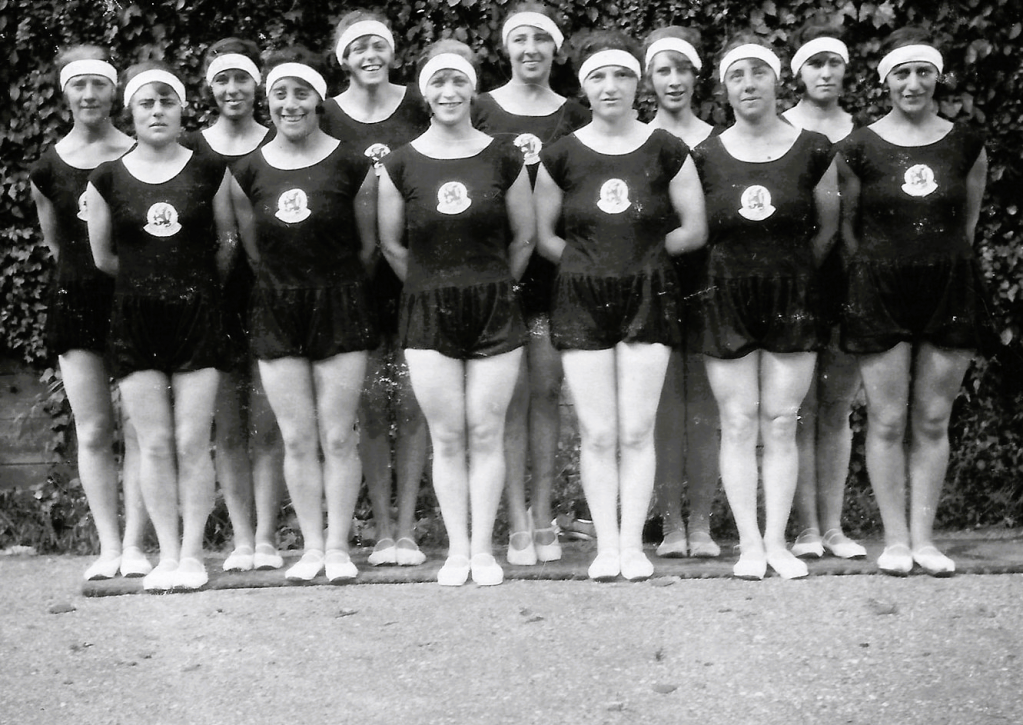
Judikje (aka Jud) Simons married Bernard Solomon Themans in 1935, and they had two children, Sonja (b. 1937) and Leon (b. 1940). They lived in Utrecht, where they ran the Jewish community orphanage. In the war period, they moved to Amsterdam together with the children and staff. Although they were warned that they were about to be arrested, they stayed at the orphanage, knowing that they couldn’t abandon the children. In early February 1943, they were arrested and incarcerated in the Westerbork concentration camp in the Netherlands. On 17 March 1943, a deportation train left Westerbork, and arrived at the Sobibor extermination camp three days later. Among the deportees were Judik Themans, her husband Bernard and their children, five-year-old Sonja and three-year-old Leon. As well as Judik and Bernard, all the children and staff from the orphanage were deported, including 30 children who had arrived from Germany. They were all murdered. Only one person survived this deportation. Of the 34,000 Jews deported from the Netherlands to Sobibor during the spring of 1943, just 19 survived.
sources
https://www.jewishvirtuallibrary.org/judikje-jud-simons
https://wwv.yadvashem.org/yv/en/exhibitions/sport/dutch-gymnastics-team.asp
https://www.joodsmonument.nl/nl/page/121826/judikje-themans-simons
Please support us so we can continue our important work.
Donation
Your readership is what makes my site a success, and I am truly passionate about providing you with valuable content. I have been doing this at no cost and will continue to do so. Your voluntary donation of $2 or more, if you are able, would be a significant contribution to the continuation of my work. However, I fully understand if you’re not in a position to do so. Your support, in any form, is greatly appreciated. Thank you. To donate, click on the credit/debit card icon of the card you will use. If you want to donate more than $2, just add a higher number in the box left from the PayPal link. Your generosity is greatly appreciated. Many thanks.
$2.00


 History of Sorts
Leave a reply to dirkdeklein Cancel reply