
On the morning of August 4, 1944, Otto Frank was helping Peter van Pels with his language lessons, while Edith Frank remained in her room. That same morning, police officers arrived at Prinsengracht 263 in Amsterdam. They proceeded to the first-floor office, where the helpers of those in hiding were working.
The officers questioned Victor Kugler and began searching the premises in his presence.

Eventually, they reached the landing with the revolving bookcase—behind which they discovered the hidden entrance to the Secret Annex and the people living there.
Along with two of the helpers, Johannes Kleiman and Victor Kugler, the eight residents of the Secret Annex were arrested and taken to the SD (Security Service) headquarters on Euterpestraat. There, the SD interrogated each person in an attempt to uncover other possible hiding addresses. Johannes and Victor remained silent. Otto Frank explained that after 25 months in hiding, they had lost contact with the outside world and were unaware of any other locations.
Following the interrogations, the group was separated. Kleiman and Kugler were transferred to the detention center on Amstelveenseweg, while the SD sent the eight individuals from the Secret Annex to Weteringschans prison.
The SD did not arrest helpers Miep Gies and Bep Voskuijl. Later, they returned to the now-empty annex. There, among the belongings left behind, they found Anne Frank’s diary papers. Miep kept them safe, intending to return them to Anne after the war had ended.

On August 4, 1944, an anonymous informant alerted the Nazis to the hiding place at Prinsengracht 263. SS officer Karl Silberbauer, accompanied by Dutch collaborators, was tasked with carrying out the raid on the Secret Annex. It was Silberbauer who personally arrested the eight Jewish occupants, including Anne Frank, her sister Margot, and their parents, Otto and Edith Frank.
Anne, only 15 years old at the time, would later die—alongside her sister—at the Bergen-Belsen concentration camp, just weeks before Allied forces liberated it. Although Anne did not survive the war, her diary, in which she vividly documented her life in hiding, did.
What if they hadn’t been found ?
If we could imagine the SD never showed up to arrest the Secret Annex dwellers, there was still a high likelihood they would have perished, as the final months of the war were the most devastating in the Netherlands—especially in Amsterdam. What follows is a brief overview of that period.
From August 4, 1944, to May 5, 1945, Amsterdam was a city on the edge—oppressed by Nazi rule, starving under blockade, and clinging to hope through one of the harshest winters in its history. The Hongerwinter was not merely a time of hunger; it was a test of the city’s endurance, humanity, and will to survive. Liberation in May 1945 marked the end of the occupation. Still, the legacy of that winter remains a profound reminder of the costs of war and the human spirit’s resilience.
By the autumn of 1944, daily life in Amsterdam had become a struggle for survival as public transportation had ground to a halt. Gas and electricity became scarce or unavailable. Heating was almost nonexistent. The city’s residents resorted to dismantling furniture, trees, and even parts of buildings to burn for warmth.
The Hongerwinter: A City Starving
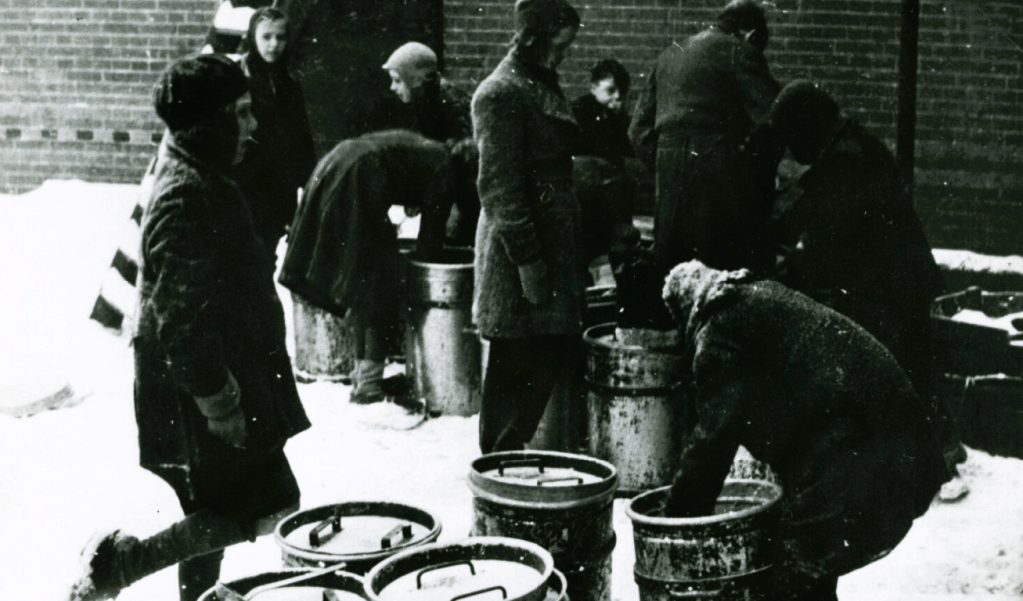
The winter of 1944–1945, known as the Hongerwinter, was particularly brutal. With temperatures plummeting and food supplies nearly exhausted, starvation became widespread. The average caloric intake for residents of Amsterdam dropped to below 1,000 calories per day—sometimes as low as 500. Bread, potatoes, and fat were almost impossible to find. People resorted to eating tulip bulbs, sugar beets, and even animal feed.
Children, the elderly, and those with pre-existing conditions suffered most. Thousands died from malnutrition and related illnesses. Hospitals were overwhelmed but lacked the supplies to treat patients effectively. Mortality rates rose sharply, and the city was cloaked in a mix of silence, desperation, and mourning.
The Dutch undertook remarkable acts of resilience and solidarity. They established illegal soup kitchens. Families in the countryside risked their lives to smuggle food into the city. Networks of resistance remained active, hiding fugitives, forging ration cards, and sabotaging German infrastructure when possible.
Liberation and the End of Occupation
On May 5, 1945, Canadian forces accepted the unconditional surrender of German forces in the Netherlands. For Amsterdam, liberation was met with a mixture of joy, relief, and grief. Crowds gathered in Dam Square to celebrate, though a tragic incident occurred on May 7 when German troops opened fire on civilians, killing at least 30 people in one of the final acts of violence in the city.
Sources
https://www.annefrank.org/en/anne-frank/go-in-depth/history-secret-annex/
https://en.wikipedia.org/wiki/Anne_Frank
https://encyclopedia.ushmm.org/content/en/article/anne-frank-biography
https://www.nationalgeographic.com/history/article/who-was-anne-frank
Please support us so we can continue our important work.
Donation
Your readership is what makes my site a success, and I am truly passionate about providing you with valuable content. I have been doing this at no cost and will continue to do so. Your voluntary donation of $2 or more, if you are able, would be a significant contribution to the continuation of my work. However, I fully understand if you’re not in a position to do so. Your support, in any form, is greatly appreciated. Thank you. To donate, click on the credit/debit card icon of the card you will use. If you want to donate more than $2, just add a higher number in the box left from the PayPal link. Your generosity is greatly appreciated. Many thanks.
$2.00
 History of Sorts
Leave a comment