
I’ve written about Eddy Hamel before, but I wanted to revisit his story as we’re in the middle of the FIFA World Cup qualifying campaign, with the finals set to take place in the United States — in East Rutherford, New Jersey in 2026. I hope his memory will be honored then.
Eddy Hamel was born in New York City to Jewish parents who had immigrated from the Netherlands. In his teenage years, he moved to Amsterdam. In 1928, he married Johanna Wijnberg, and in 1938, they had twin boys, Paul and Robert.
Hamel holds a unique place in football history as both the first Jewish player and the first American to play for Ajax, one of Amsterdam’s—and Europe’s—most renowned football clubs. Before joining Ajax, he played for Amsterdamsche FC (AFC). His first encounter with Ajax was rather memorable. While training with AFC, Hamel accidentally broke a window in an Ajax changing room. The groundskeeper wasn’t pleased and gave him a stern scolding. Despite this rocky introduction, Hamel joined Ajax in 1922, making history as the club’s first Jewish player and first American. The Ajax supporters—many of whom were also of Jewish heritage—quickly took him into their hearts.
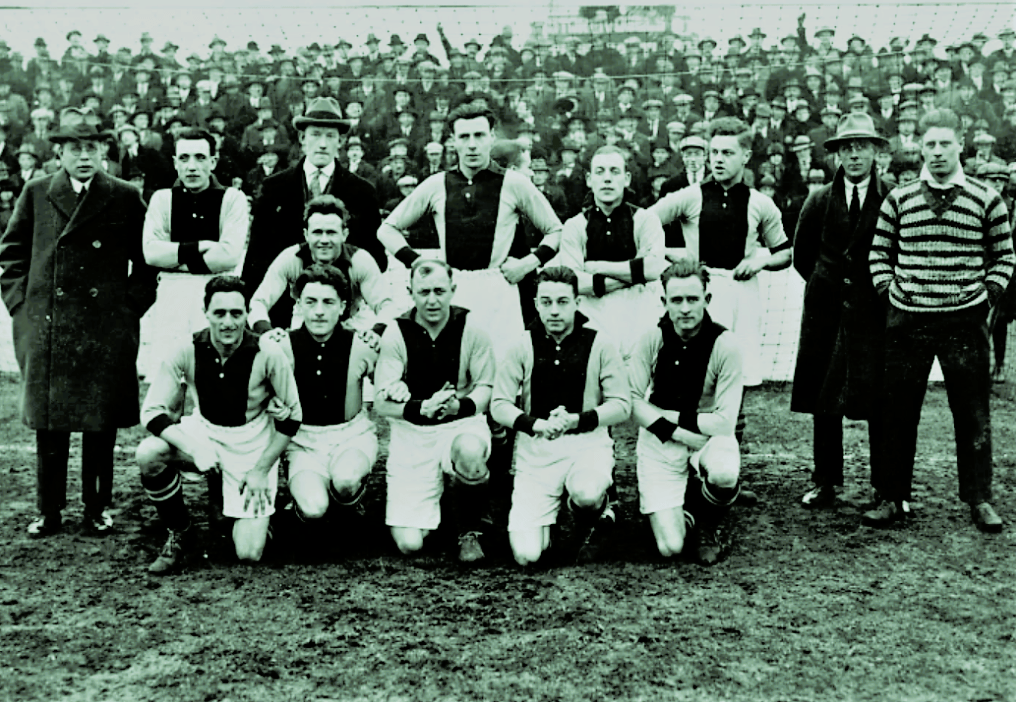
Hamel soon became a first-team regular and a fan favorite. To this day, only four other Jewish footballers have followed in his footsteps at Ajax: Johnny Roeg, Bennie Muller, Sjaak Swart, and Daniël de Ridder. Pre-World War II club legend Wim Anderiesen even named Hamel in the strongest line-up he had ever played with. Hamel’s popularity extended off the field as well, with his own fan club forming in the 1920s. These supporters would position themselves on his side of the pitch at the start of every match and then switch sides to follow him in the second half. After retiring from playing, Hamel managed Alcmaria Victrix for three years and continued to play with Ajax’s veteran squad.
Hamel, his wife, and their sons lived in a second-floor flat at 145 Rijnstraat, not far from where the Frank family, including a young Anne Frank, lived. Even during the German occupation of the Netherlands, Hamel defied Nazi rules and continued to play for Ajax’s alumni team, Lucky Ajax.
However, on October 27, 1942, Hamel was stopped by two officers from the Jewish Affairs division of the Amsterdam Police, who had become collaborators with the Nazis. The arrest report, written in German, notes that Hamel informed the officers that he was born in New York and listed his profession as a coach. His arrest was because he had been seen in public “sich ohne Judenstern”—without the Jewish star that Jews were required to wear. Despite his American citizenship, Hamel was detained by the Nazis due to his Jewish identity.
Hamel and his family were forced to report to Westerbork transit camp. They were placed in the “English Barrack,” where British and American citizens, considered eligible for exchange, were held. However, this status did not offer them protection. Leon Greenman, who was held in the same barracks, spent the last few months with Eddy. In January 1943, both families were deported to Auschwitz. Upon arrival, the women and children were immediately murdered. Eddy and Leon were forced to work.
Eddy endured four months of hard labor at Birkenau. However, after a Nazi inspection revealed that he had a swollen mouth abscess, he was sent to the gas chambers in Auschwitz on April 30, 1943, where he was murdered.
Though we can’t be sure, Eddy Hamel would have taken an interest in watching the young talents at Ajax, even during those dark times. He likely would have enjoyed seeing the promise of Rinus Michels, who played for the Ajax youth team in 1940/1941. Michels went on to become the most successful manager in the history of the Dutch national team, leading them to a European Championship title in 1988.

Eddy Hamel’s story is one of both achievement and tragedy. As one of the first American soccer players to make a mark on European football and as the first Jewish player to represent Ajax, his contributions to the sport were significant. His murder in Auschwitz, however, represents the brutal destruction of potential that characterized the Holocaust. Hamel’s story serves as a reminder of the countless lives—Jewish, Roma, political dissidents, and others—lost to Nazi terror.
Despite his tragic end, Hamel’s legacy has not been forgotten. In recent years, both Ajax and the broader footballing community have taken steps to honor his memory. Ajax, a club with deep Jewish roots and a strong Jewish fan base, has worked to preserve the memory of Hamel as a symbol of resistance against anti-Semitism and intolerance. The club’s Jewish identity, represented by the nickname “Joden” (Dutch for “Jews”), has remained an integral part of its culture, with fans chanting and waving Israeli flags during matches as a sign of solidarity.
In 2012, Ajax held a special ceremony to honor Hamel and other Jewish victims of the Holocaust, cementing his place in the club’s history. His story is a reminder of the responsibility that sports organizations have to educate their players and fans about historical injustices and to combat racism, xenophobia, and anti-Semitism in all its forms.
Sources
Donation
Your readership is what makes my site a success, and I am truly passionate about providing you with valuable content. I have been doing this at no cost and will continue to do so. Your voluntary donation of $2 or more, if you are able, would be a significant contribution to the continuation of my work. However, I fully understand if you’re not in a position to do so. Your support, in any form, is greatly appreciated. Thank you. To donate, click on the credit/debit card icon of the card you will use. If you want to donate more than $2, just add a higher number in the box left from the PayPal link. Your generosity is greatly appreciated. Many thanks.
$2.00

 History of Sorts
Leave a comment