Lynn is a psychotherapist and clinical social worker. She is the daughter of two Holocaust survivors. In the interview, we discuss the mental impact her parents’ ordeal had on her and also how that translated into her work as a psychotherapist. She was voted The Best Therapist of 2008 by the Main Line Times newspaper in Pennsylvania, USA, and she specializes in anxiety, trauma, PTSD, and grief.
The story of her parents isn’t just a story of survival. It is a story of kindness and bitterness, a love story, a story of perseverance. It is also a tale of despair and disappointment but in equal measure—a story of victory and hope.
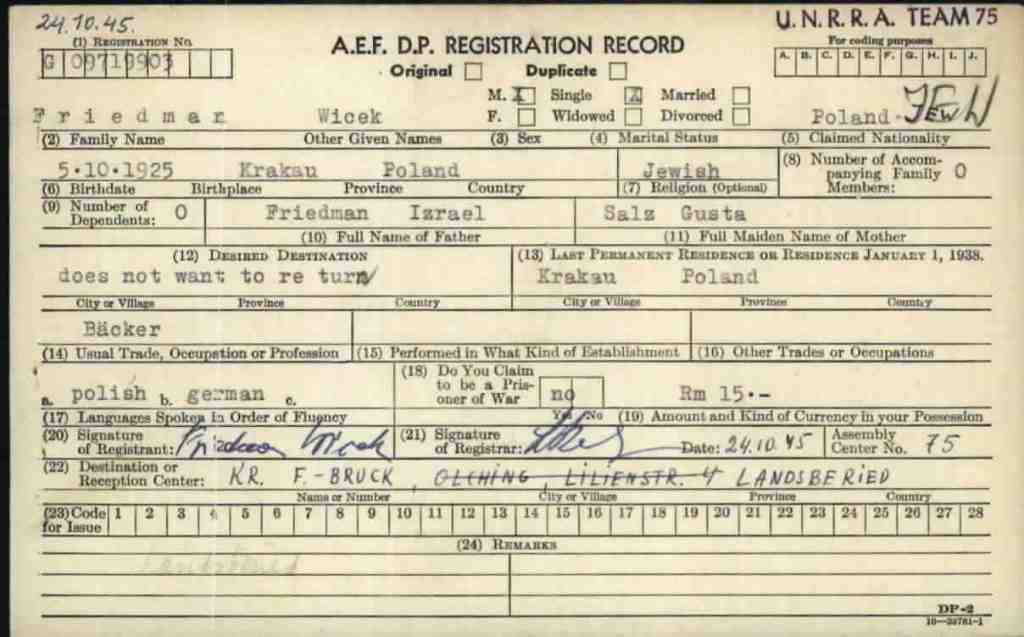
Lynn sent me a number of documents relating to her father, Wicek Friedman, which changed to Victor Friedman. That fact on its own is a good indication that after the Holocaust, the struggle continued—changing your name is not something you do lightly. I presume he changed it to make it easier for the people in his adopted land to be able to pronounce his name. I say adopted land because that is what struck me when I saw the document of the Displace Persons registration (photo at the top), which says, “Does not want to return.” He was born in Krakow, Poland on October 5, 1925.

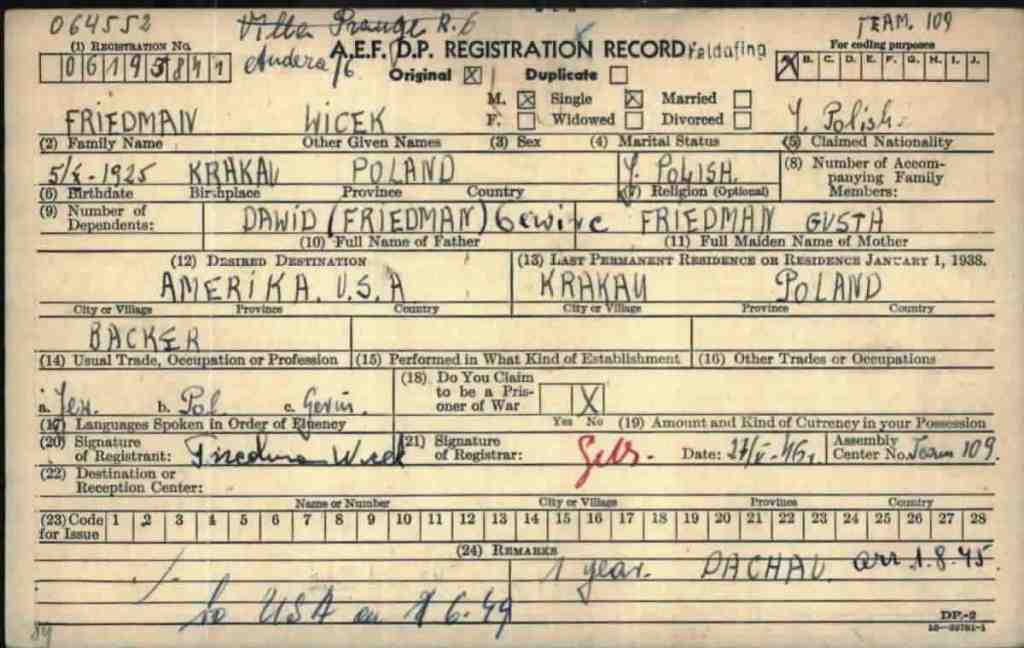
Victor survived Auschwitz (where he escaped), Sachsenhausen, and Dachau. Lynn received the following information about her father from the International Tracing Service.
“Your father was in Auschwitz Concentration Camp where he had two prisoner numbers, 110225 and 199815. At the beginning of May 1944, he was arrested in Kolozsvár, Hungary, and sent by the Security Police in Budapest to Sachsenhausen Concentration Camp in Germany. On November 17, 1944, Wicek was transported to Dachau Concentration Camp in Germany. His Dachau prisoner number was 127009.”
Lynn’s mother, Ella, had also been in Dachau. She was born in Berehova, Berkstad, Czechoslovakia in 1927. After she saw how Victor had been tortured for stealing potato skins to give to those who were starving, she told a friend, “Do you see that brave man—if he survives, I will marry him.”
They did get married in 1950.

Victor and Ella had different outlooks after the war. Victor, although he survived, had many medical complications due to the torture he received in Dachau. Victor’s aim was to replace the horrors he witnessed with acts of kindness. Sadly, he passed away in 1974, just before his 49th birthday. What saddened me to hear is that Victor knew that the hate against the Jews had not disappeared after the Holocaust. He advised his daughter to always be ready to leave.
Ella was basically always in survivor mode as she didn’t show love towards her children. That is not uncommon with survivors—and in a way—it is understandable because she had lost many of her family. She probably was afraid to get too attached again.
She had lied about her age when she was taken to Dachau, giving her year of birth as 1929, but in fact, it was 1927. She reckoned she would have a better chance of survival if the Nazis thought she was younger. Her younger sister had been murdered by the Nazis when she was at the train station—they shot her. Ella passed away in 2017.
This is Lynn speaking about her parents, and it’s just as important as her own experiences.

Source
https://www.ancestry.com.au/genealogy/records/victor-friedman-24-4svr3p
 History of Sorts
Leave a comment