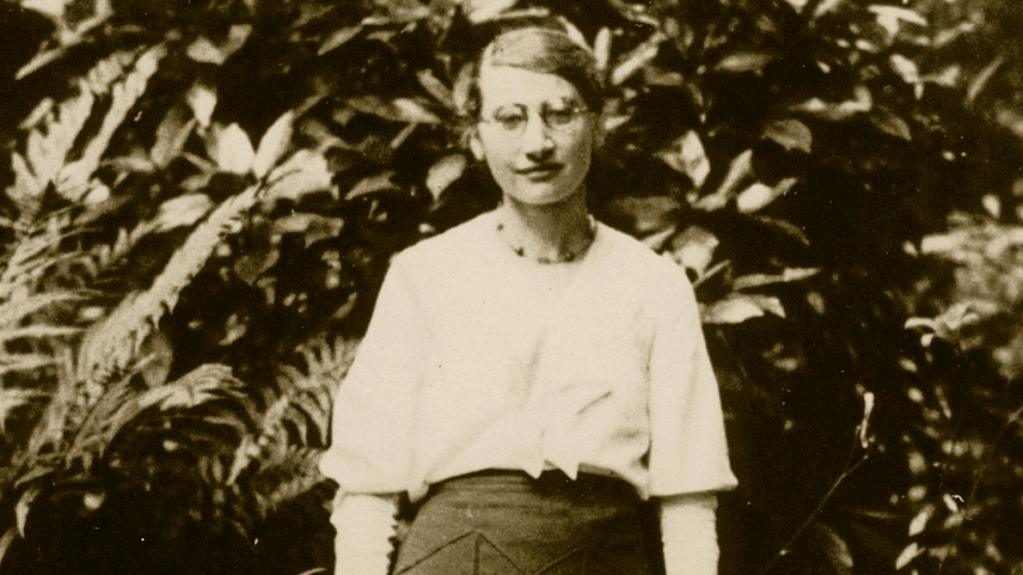
Luise Löwenfels (was a German nun of Jewish descent who is remembered for her courage and faith during the Nazi era. Her story is one of personal sacrifice, spiritual conviction, and tragic martyrdom.
She was born on July 5, 1915, in Eschweiler, Germany, into a Jewish family. Her parents, both of Jewish heritage, raised her in the Jewish faith. Growing up in Germany during the turbulent period leading up to the Nazi regime, Luise experienced the increasing anti-Semitism that would later engulf Europe.
She was the daughter of Salomon Löwenfels and Sophie Prölsdorfer. Although she grew up in a religious Jewish family, she felt drawn to the Catholic faith.
Luise’s spiritual journey took a significant turn in her youth when she converted to Christianity. This conversion was a profound and personal decision that led her to join the Catholic Church. She later decided to dedicate her life to God by joining a religious order. On November 25, 1935, she was baptized and received the name Maria Aloysia in 1937.
Luise Löwenfels’ connection to Geleen, a small town in the Netherlands, is an integral part of her story, particularly in the context of her final years during World War II.
As the persecution of Jews intensified in Nazi Germany, Luise Löwenfels, already a member of the Catholic Church and a nun, sought refuge outside Germany. She fled to the Netherlands, which at that time was seen as a relatively safe haven for those escaping Nazi terror.
In Geleen, a town in the Dutch province of Limburg, Luise found shelter with her religious order, the Congregation of the Sisters of the Divine Redeemer, which had a convent in the area. The community in Geleen became her new home, where she continued her religious life and work in relative obscurity.
While in Geleen, Luise continued her work as a nun, living according to the rules and spiritual practices of her order. The convent in Geleen was part of a broader network of religious institutions in the Netherlands that provided sanctuary for those fleeing the Nazis. Luise’s life in the convent was marked by her dedication to her faith and service despite the growing dangers around her.
In May 1940, Nazi Germany invaded and occupied the Netherlands, bringing the horrors of the Holocaust to Dutch soil. The situation for Jews and those of Jewish descent, like Luise, became increasingly perilous.
On July 20, 1942, Johannes de Jong, the Archbishop of Utrecht, issued a pastoral letter to be read in all churches, protesting against the deportation of the Jews. In response, 244 former Jews who had converted to the Roman Catholic Church were arrested by the Gestapo on August 2, 1942, and taken via the Amersfoort transit camp to the Westerbork transit camp and finally to the Auschwitz Extermination Camp.
After her arrest, Luise was deported from the Netherlands. She was first sent to the Westerbork transit camp. From Westerbork, she was deported to Auschwitz, where she was murdered on September 30, 1942. Although some sources say she was murdered on August 9, 1942.
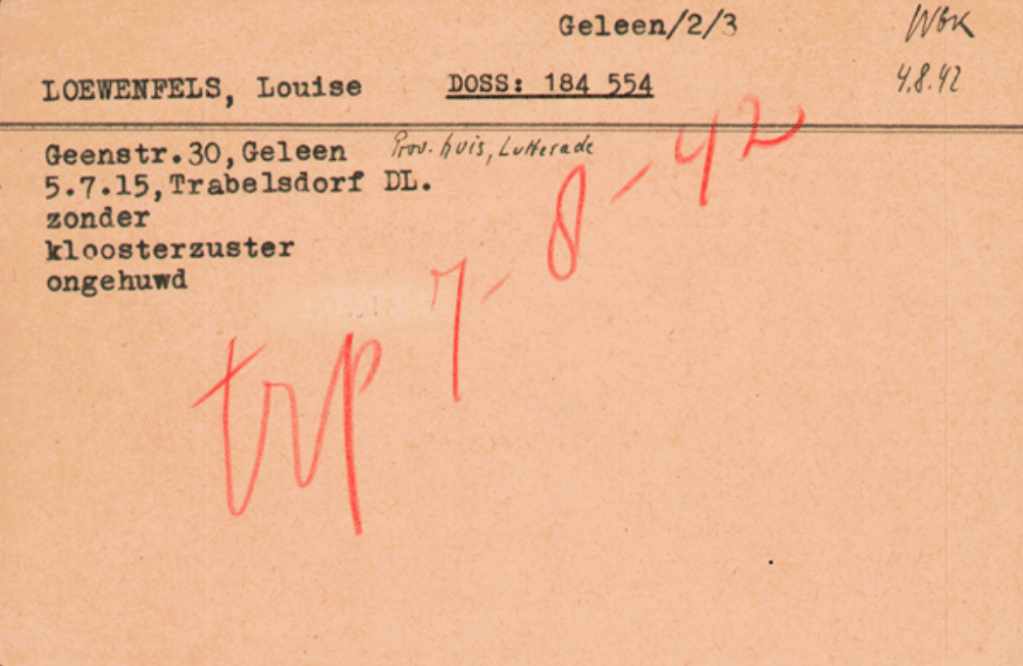
Together with dozens of other Catholic converted Jews, including Edith Hedwig Stein [St. Teresia Benedicta of the Cross, OCD] and her sister Rosa Adelheid Stein, who both lived in the nearby convent of Echt,
The town of Geleen, like many other places touched by the Holocaust, has made efforts to remember those who perished. Luise Löwenfels is remembered not only for her tragic death but also for her life of service and faith. Her story is part of the collective memory of the community. It serves as a reminder of the dark history of the Nazi occupation.
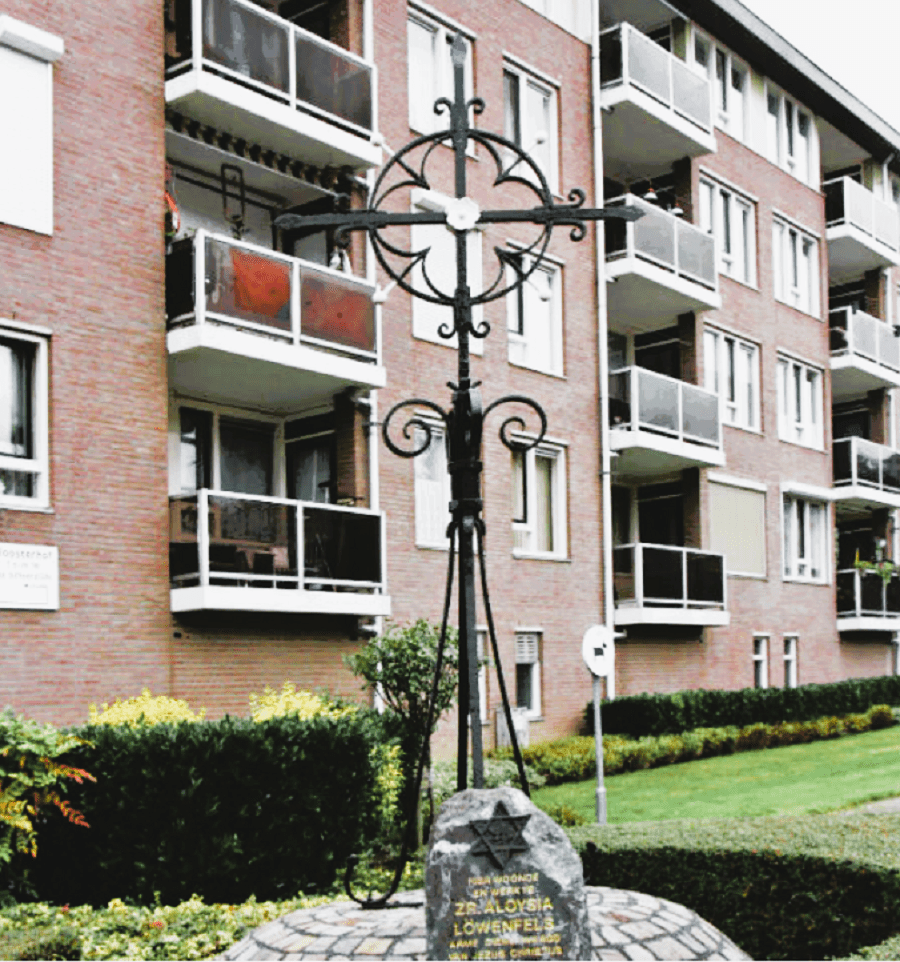
The convent was destroyed in October 1942 by an Allies bombing campaign, who had mistaken Geleen for nearby Aachen in Germany. On June 28, 2006, a monument in remembrance of Sr. Maria Aloysia Löwenfels was placed approximately where the old convent once stood.
In 1994, I actually bought an apartment across from the spot of the old convent, not realizing the historical relevance.
In 2015, the Apostolic administrator of the German diocese Limburg started the canonization procedure (the official process for declaring someone a saint) for Sr Aloysia to have her declared a Martyr.
Sources
https://www.ushmm.org/online/hsv/person_view.php?PersonId=12692009
https://www.joodsmonument.nl/nl/page/535941/about-luise-lowenfels
https://www.tracesofwar.com/sights/23412/Jewish-Memorial-Zuster-Aloysia-Geleen.htm
https://bistumlimburg.de/beitrag/seligsprechungsverfahren-fuer-luise-loewenfels-eroeffnet/
https://www.findagrave.com/memorial/220108717/luise-l%C3%B6wenfels
Donation
Your readership is what makes my site a success, and I am truly passionate about providing you with valuable content. I have been doing this at no cost and will continue to do so. Your voluntary donation of $2 or more, if you are able, would be a significant contribution to the continuation of my work. However, I fully understand if you’re not in a position to do so. Your support, in any form, is greatly appreciated. Thank you. To donate, click on the credit/debit card icon of the card you will use. If you want to donate more than $2, just add a higher number in the box left from the PayPal link. Your generosity is greatly appreciated. Many thanks.
$2.00


 History of Sorts
Leave a comment