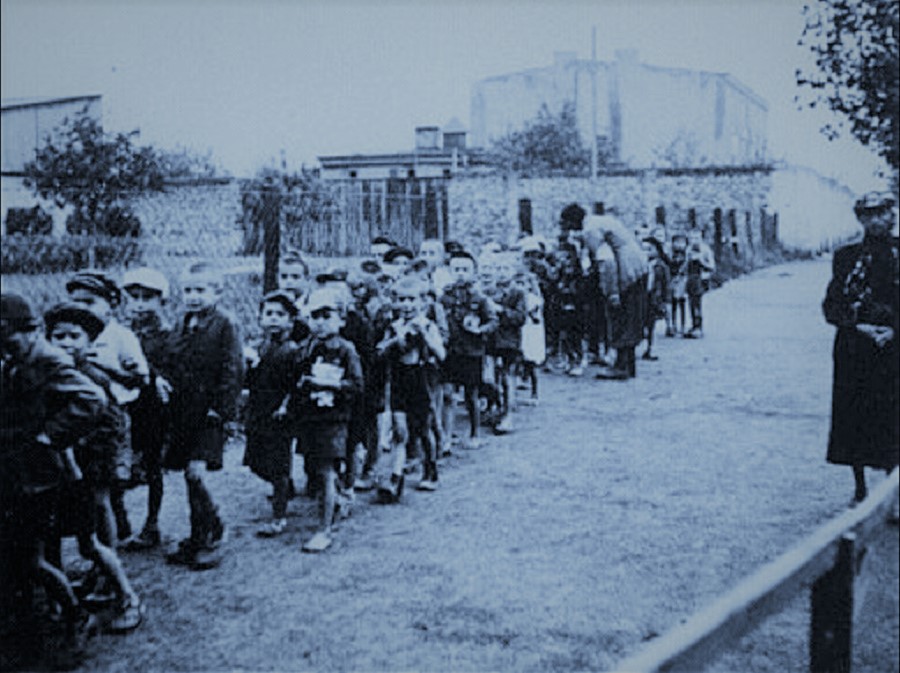
I wanted to change the title of the blog to evoke an emotion, but then I thought: if this picture doesn’t hit you in the gut, perhaps nothing will.
The title is actually the title of the original photograph, which is in the public domain. I have only changed the names from their German forms to their Polish names.
If you didn’t know the story behind this photograph, you might simply think it was an old picture of a group of primary-school children on their way to a field trip. There are about thirty of them, walking together along a road. They look like children anywhere in the world: young, vulnerable, and seemingly unaware of what lies ahead.
I regularly see a group of children of roughly the same size walking from the local primary school to the leisure centre, about half a mile down the road. It is the same centre I attend, and the children go there for swimming lessons. My own children were pupils at that school. They would have walked that same route.
That is what makes this photograph so difficult for me to look at.
These children were not going on a school outing. They were being rounded up and transported to a place where they would be murdered.
There are only two adults clearly visible in the photograph. Near the rear of the group, a man appears to be bending down, perhaps giving instructions to the children. He is wearing an armband. I cannot say with certainty who he was; he may have been a prisoner functionary such as a Kapo or a member of a Sonderkommando, but the photograph alone cannot establish his identity or role.
At the right edge of the photograph stands a woman. She may simply have been a bystander. My own impression is that she could have been a female guard, but again, that cannot be established from the photograph alone.
What disturbs me most is the knowledge that at least some of the adults involved in these transports knew what was happening to the children. Whether they participated willingly, under coercion, or somewhere between those extremes, the image forces me to confront something I find almost impossible to comprehend: these were children, and yet they were being led towards death.
I could not do that. I cannot imagine standing there, knowing what awaited those children, and continuing to participate. I would rather die myself.
And time and time again, I find myself asking the same question:
Why the children?
I know the historical answer. The Nazis and their collaborators did not see Jewish children as innocent human beings with lives ahead of them. They were classified as part of an enemy population, dehumanised by racist ideology and, in the logic of genocide, regarded as future members of the group the Nazis sought to destroy.
But knowing the explanation does not make it comprehensible.
Perhaps that is because there is no moral logic to it. There is only the twisted logic of an ideology that had reduced human beings to racial categories and ultimately decided that even a child could be condemned simply for having been born.
There is a line from a Whitney Houston song that I have always found beautiful:
“I believe the children are our future,teach them well and let them lead the way.Show them all the beauty they possess inside.”
Those words take on an almost unbearable meaning when placed beside this photograph.
Children are the future. They are the laughter in the next generation, the people who will grow up, have families of their own, build things, create things, love, argue, learn, make mistakes and perhaps make the world a little better than the one they inherited.
By murdering children, you do not simply take their lives. You destroy all the futures . theirs and ours.
That is what I see when I look at this photograph.
And perhaps that is why I will never again look at a group of schoolchildren walking down a road in quite the same way.
Whenever I see children leaving the local school for a swimming lesson, a field trip, or simply walking together with their friends, I will think of these children.
I will think of the photograph.
And I will hope—and pray—that no child will ever again be rounded up, deported and sent to a place of death simply because of who they were or the family into which they were born.
But I will also look at those children a little differently.
I will notice their laughter.
Their smiles.
The noise they make as they walk together.
The ordinary, beautiful chaos of childhood.
And I will appreciate it just a little more than I did before.
Because somewhere in that photograph are thirty children who should have grown up.
And they never got the chance.
Source
USHMM


Leave a Reply