
Friedrich “Fritz” Pfeffer was born on April 30, 1889, in Gießen, Germany, into a Jewish family that owned a bustling clothing store in the city’s center. Bright and ambitious, Fritz pursued dentistry in Berlin, eventually establishing a successful practice.
After completing his education, Fritz trained as a dentist and jaw surgeon, obtained a license to practice in 1911, and opened a surgery the following year in Berlin.
He served in the German Army during the First World War, serving in the 116th Infantry Regiment. This regiment’s division took part in the battles of Verdun and the Somme. Back in Berlin, he resumed his practice. He was also an active sportsman, particularly into rowing in the waters around Berlin.
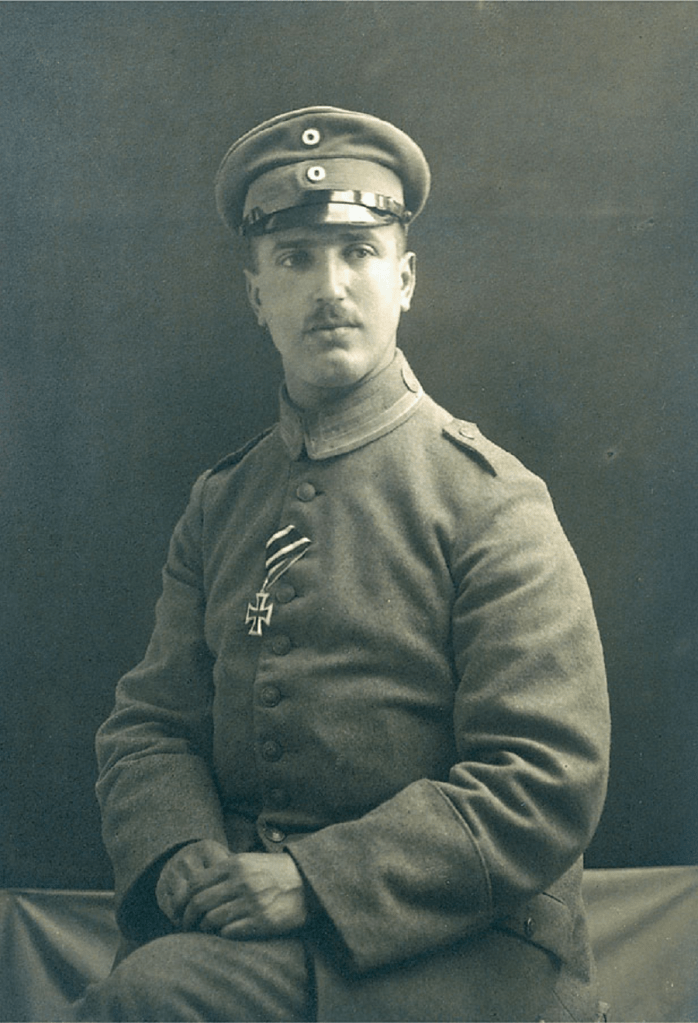
In 1926, Fritz married the vivacious Vera Henriette Bythiner. A year later, they welcomed their son Werner into the world. But their happiness was short-lived. By 1933, the marriage had ended in divorce, and Fritz gained custody of Werner. It was a turbulent time—Nazi Germany’s rise to power brought devastating changes. Fritz’s dental practice faced mounting restrictions, eventually forcing him to work illegally. During this period, he found solace in a relationship with Charlotte Kaletta, a Catholic woman, despite the anti-Semitic laws that forbade their union.
Pfeffer attempted to emigrate to the United Kingdom, but on 5 May 1937, his application for registration as a dentist—was rejected by the General Medical Council (GMC) in London His younger brother Ernst Pfeffer had made the same request a year and a half earlier and admitted.
As persecution escalated, Fritz and Charlotte made the heart-wrenching decision to flee Germany after the horrors of Kristallnacht. Fritz managed to send his son to England via Kindertransport, entrusting Werner’s care to his brother Ernst.
In December 1938, Werner Pfeffer embarked on a journey that would change his life forever. As part of the very first Kindertransport, he traveled by train from Berlin to the Hook of Holland, a trip that captured the attention of the Dutch press. The harrowing yet hopeful journey of these refugee children was even filmed, marking a poignant moment in history.
Under the care of the Refugee Children’s Movement and registered as child number 15252, Werner boarded the S.S. Prague, a ferry operating the route between the Hook of Holland and Harwich.

Arriving in Harwich by night boat on December 2, 1938, Werner entered England—a place of refuge but also of uncertainty. There, he was welcomed by volunteers and placed under the supervision of the Refugee Children’s Movement, a testament to the collective efforts to save children from the horrors of Nazi Germany.
Meanwhile, Fritz and Charlotte sought refuge in the Netherlands. In Amsterdam, Fritz became acquainted with Otto Frank and a network of friends who often gathered for lively Saturday afternoons.
When the Nazi raids intensified, Fritz sought a hiding place. Miep Gies, a trusted helper of the Frank family, facilitated his inclusion in the Secret Annex. On November 10, 1942, Anne Frank wrote in her diary with excitement: “Great news, we want to take in an eighth hider!”

Fritz arrived at Prinsengracht 263 to find a surprising setup: a hiding place inside a business and a mix of families he didn’t expect—he’d thought the Franks had fled to Switzerland. Sharing a small room with the spirited Anne quickly proved challenging. Anne described his Sunday prayers with a mix of humor and irritation: “He rocks back and forth from his heels to his toes for fifteen minutes… back and forth, back and forth—it goes on endlessly.”

Their clashing personalities led to frequent tensions. Anne found him critical and overbearing, while Fritz likely found her exasperating.
Despite the difficulties, Fritz held onto dreams of a brighter future. Through Miep, he managed to exchange letters with Charlotte, who lived unknowingly close by in Amsterdam. He immersed himself in learning Spanish, envisioning a post-war life with Charlotte in South America.
Tragically, this dream was never realized. After the Secret Annex was betrayed, Fritz was deported to Auschwitz via Westerbork. At Auschwitz-Birkenau, he was subjected to grueling forced labor, building roads in brutal conditions. In November 1944, Fritz was transferred to Neuengamme concentration camp near Hamburg, where the harsh environment killed him on December 20, 1944, at the age of 55.
Charlotte survived the war and later received retroactive recognition of their unfulfilled marriage, dated May 31, 1937. She lived the rest of her life in Amsterdam and passed away in 1986.
Fritz’s son Werner emigrated to the United States after the war, carving out a successful career in trading. He lived until February 14, 1995, carrying forward the legacy of a family fractured by the Holocaust but resilient in its memory.
Sources
https://www.annefrank.org/en/anne-frank/main-characters/fritz-pfeffer/
https://www.joodsmonument.nl/nl/page/220901/friedrich-pfeffer
https://research.annefrank.org/en/personen/ebfcf860-0a6a-45d6-bfb5-d2a31bbf01a6/
https://www.nli.org.il/en/a-topic/987007266579005171
Donations
Your readership is what makes my site a success, and I am truly passionate about providing you with valuable content. I have been doing this at no cost and will continue to do so. Your voluntary donation of $2 or more, if you are able, would be a significant contribution to the continuation of my work. However, I fully understand if you’re not in a position to do so. Your support, in any form, is greatly appreciated. Thank you. To donate, click on the credit/debit card icon of the card you will use. If you want to donate more than $2, just add a higher number in the box left from the PayPal link. Your generosity is greatly appreciated. Many thanks.
$2.00

 History of Sorts
Leave a reply to tzipporahbatami Cancel reply